
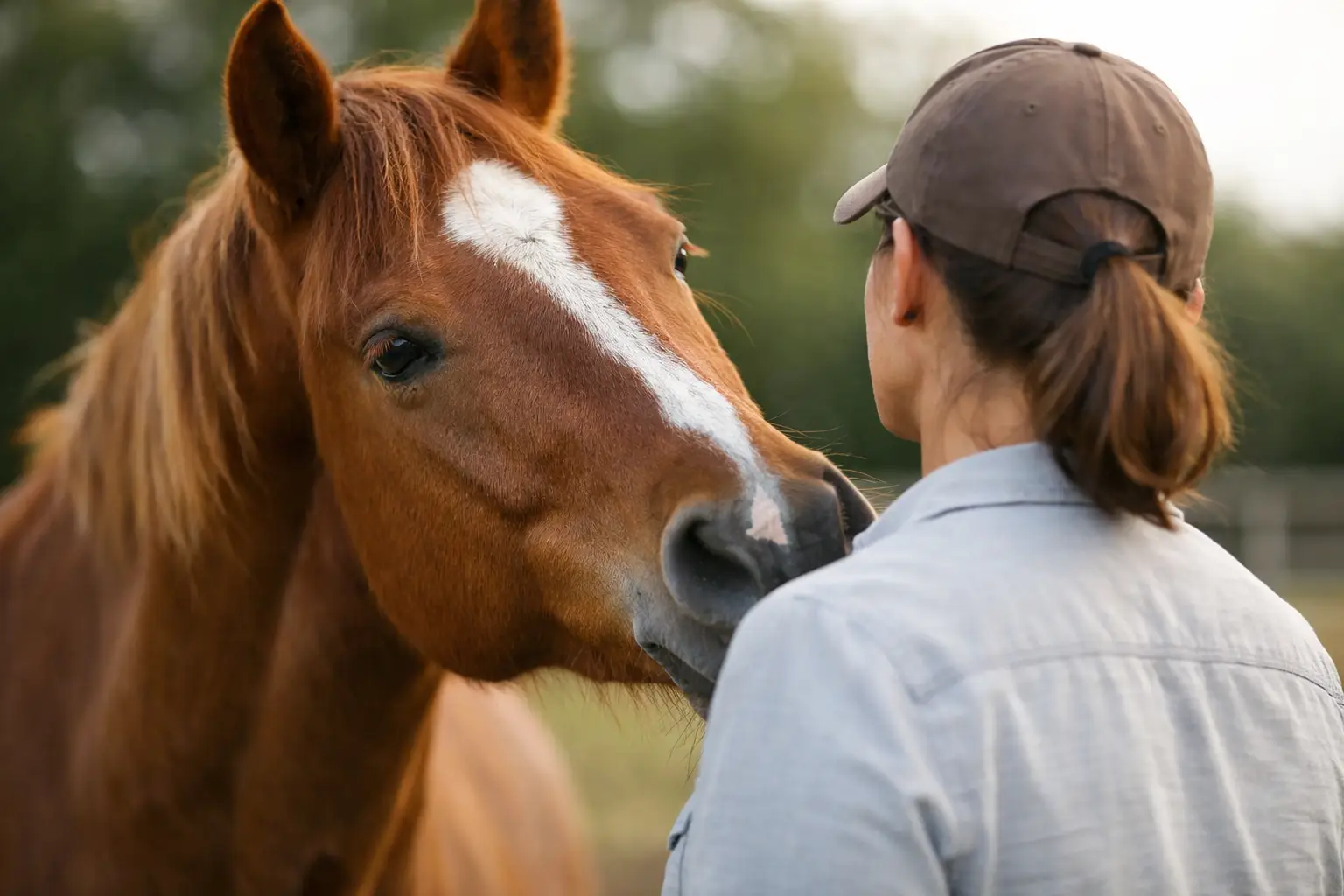

He puts his head over your shoulder. Nudges your pockets. Keeps walking when you stop. It looks affectionate, doesn't it?
I want you to take this question seriously anyway, especially if you're newer to ownership or your confidence has already taken a knock. A horse who regularly crowds you isn't necessarily naughty or dominant. But if he can't recognise a boundary when you ask for one, a small habit like this can quietly turn into something bigger, like barging at the gate, dragging you toward grass, or knocking you over while being led.
Here's the Real Reason It's Happening
I'll tell you the honest, slightly uncomfortable truth: most horses crowd people because, at some point, it worked. He stepped closer, you stepped back, and he learned that being close changes your feet, your attention, your decisions. Horses learn from release and repetition, not from being told off. If you lead him and automatically make room every time he drifts into you, he's not "taking charge." He's just learned your space is available. This is why I see pushiness as an unconscious handling pattern almost every time, not a deliberate failure on the owner's part. There's usually more going on underneath it too. A few common causes I see:- Anxiety, where he's leaning on the person he trusts because something feels unfamiliar
- Food association, especially if hand-feeding has happened without clear manners
- A young or green horse who genuinely doesn't understand how much room his own body takes up
- Simple habit, built one small, unnoticed step at a time
Affection and Crowding Are Not the Same Thing
I get why owners hesitate to set a boundary here, because you don't want to reject the horse who greets you at the gate every morning. That bond matters, genuinely. But a safe relationship doesn't require you to be a leaning post. Here's the test I'd actually use: can you ask for space without an argument? Step toward his shoulder, or ask him to back up, and see whether he yields softly or braces and ignores you. That answer tells you far more than the fact that he likes being close to you.When This Becomes a Genuine Safety Issue
A 500-kilo horse doesn't need to be aggressive to hurt you. One misplaced foot breaks a toe. A shoulder barge puts you on the ground. I'd want you paying particular attention around the high-pressure moments:- Catching and feeding
- Leading through gates
- Float loading
- Grooming and saddling
How I'd Actually Respond, Without Making Him Fearful
Start by getting honest about your own habits, beyond his alone. Do you step away before he's actually yielded? Do you keep walking while he's glued to your shoulder? Horses notice the smallest patterns. If he can move your feet, he's already received his answer. Here's the shift I'd want you making: ask for one small, clear response, then soften the instant he gives it to you. Timing matters so much more than force here. You're not trying to chase him off. You're showing him he can be comfortable near you without being on top of you. If food's part of the picture, stop rewarding the mugging. Offer treats only when he's standing where you actually want him, with a quiet head and respectful distance.Firmness and Force Are Not the Same Thing
Some people get told to be bigger and louder when a horse crowds them. Others get told any boundary at all is unkind. Neither extreme actually helps. Firm means clear, timely and consistent. Force means escalating because you're frustrated or frightened. A worried horse reacts badly to force. A confident, pushy horse just gets more defensive. Either way, you lose the conversation you were trying to have in the first place. There will be days you don't feel able to handle this alone, and I want you to listen to that feeling rather than push through it. Ask an experienced horseperson to actually watch the interaction and explain what they're seeing, rather than simply take the rope and make the problem disappear while you stand there feeling no more capable than before.Here's What I Actually Built to Fix This Properly
I could keep listing small tips here, but here's the honest truth: crowding almost always comes back to one specific, unconscious habit on the human end of the rope, something you're doing without even realising it, every single time you step aside to make room. Once you can actually see that habit, the fix tends to move fast. That one habit, and exactly how to reverse it, is the whole focus of my Claim Your Space mini course, two short videos and a cheatsheet, built to be used at the paddock rather than simply read about at your kitchen table.If You're Looking at a Horse to Buy
Crowding is one behaviour worth watching for before you fall in love. Watch him being caught, led and fed by his usual handler. Then, if it's safe, handle him yourself and see if anything changes. A few things worth noticing during a viewing:- Does he wait politely at the gate, or push through?
- Does he lead beside you, or drag ahead?
- Does he respect a request to back up, or ignore it entirely?
💛 Claim Your Space - $27
A short, focused mini course that shows you the one unconscious handling habit behind almost all pushy, space-invading behaviour, and exactly how to reverse it before your next trip to the paddock. 👉 Watch Claim Your Space Here