
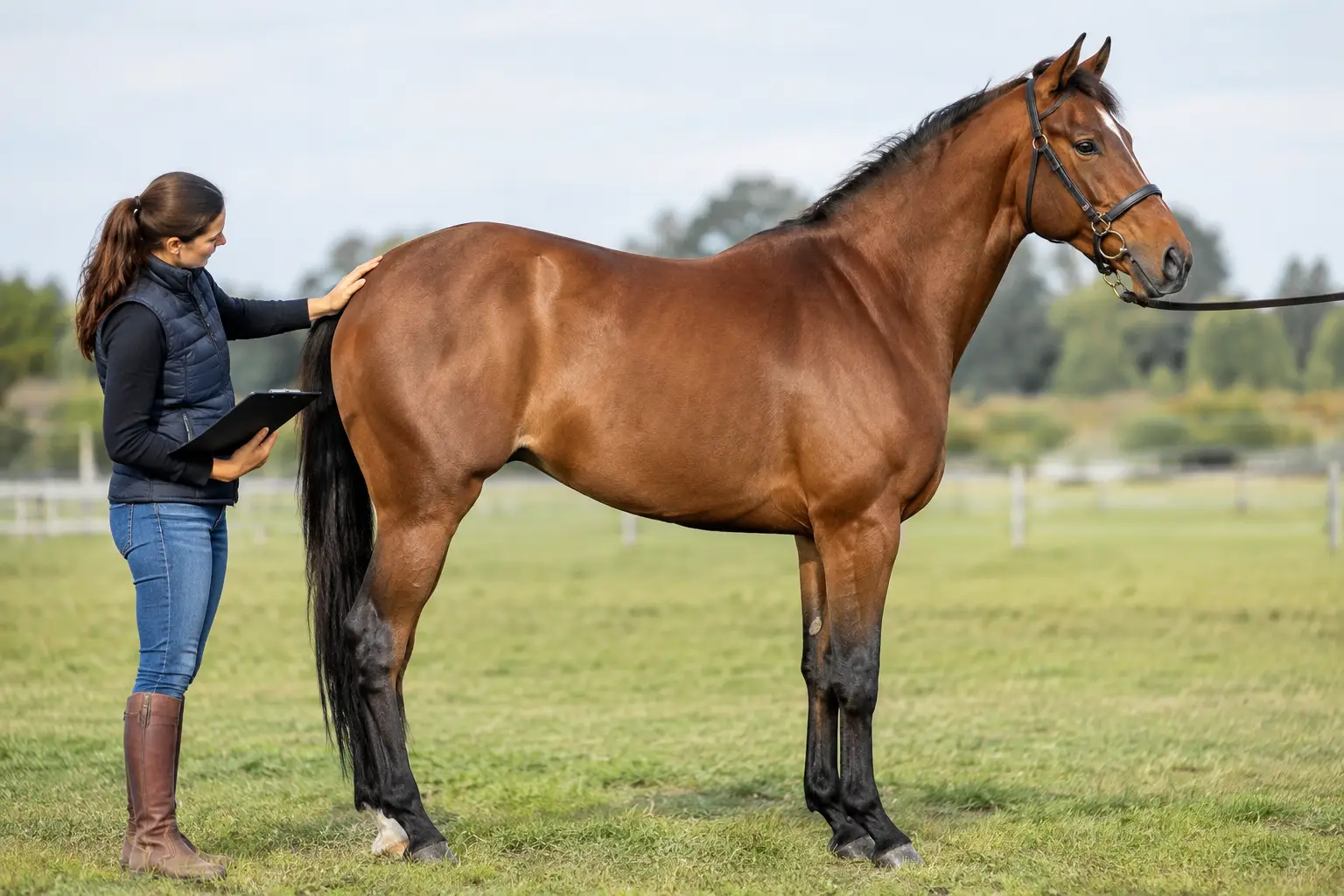
A pretty head, shiny coat and impressive movement can make it very hard to think clearly. But if you are learning how to evaluate horse conformation, your job is not to find a perfect horse. It is to spot whether that horse’s body is likely to stay comfortable doing the work you want to do - and whether any limitations are being honestly presented.
Conformation matters because it affects soundness, comfort, movement and durability. It can also affect behaviour. A horse who is repeatedly sore, struggling to balance, or unable to use their body easily may become tense, unwilling or reactive. That does not make them a bad horse. But it may make them the wrong horse for the job, or too much risk for your budget and experience.
No amount of good conformation guarantees a sound horse, and a horse with an imperfect leg or a slightly crooked marking can still have a long, useful life. This is about making a more informed decision, not playing veterinarian from the end of the lead rope.
Start with the whole horse, not one fault
Stand well back before you start inspecting details. Ask to see the horse on level, firm ground, standing square if possible. A horse parked unevenly on a slope, posed to hide a leg, or constantly shifted about is difficult to assess fairly. Take your time. If you feel rushed, that is information too.
Look at the horse from both sides, from the front and from behind. Then watch them walk and trot away from you, towards you and side-on. Photos can be useful, but only if they are taken on flat ground with the horse standing naturally. Clever angles can make a short neck look long, a downhill horse look level, and uneven feet disappear.
Your first question is simple: does the horse look balanced as a whole? Balance does not mean every body part is identical. It means the horse appears put together in a way that allows weight to be carried and movement to flow without one area doing all the work.
How to evaluate horse conformation for balance
From the side, consider the three main sections of the body: forehand, barrel and hindquarters. They should look reasonably proportional. A horse that is very heavy in front with a weak hindquarter, for example, may find it harder to shift weight back and carry themselves in collected work. That may matter greatly for dressage, jumping or regular hill work, and less for a quiet paddock companion doing occasional light trail rides.
Look at the topline. Is the back excessively long, weak-looking or dipped? Is the loin - the area between the last rib and the hindquarters - very long or poorly muscled? A longer back is not automatically a deal-breaker, but it can make carrying a rider and staying strong through the middle more challenging, particularly if the horse will do demanding work.
Notice the horse’s neck and how it joins the shoulder. A neck that is very low-set, thick underneath or tied in tightly can make balance and flexibility harder. Again, context matters. A horse built for pulling or stock work will not look like a refined sport horse, and it should not be judged against one. What matters is whether their build suits the work you actually plan to ask of them.
Also look at shoulder and hip angles. A reasonably sloping shoulder often supports a freer, more comfortable stride, while a very upright shoulder can be associated with shorter movement. A long, well-muscled hip can support power from behind. But do not buy a horse based on angles alone. You need to see whether those parts work well in motion.
Check the legs and feet with a critical eye
Legs and feet carry the whole horse. They deserve more of your attention than the colour of the coat or the size of the float rug included in the sale.
Stand directly in front of the horse and look down both front legs. Then stand behind and assess the hind legs. You are looking for legs that appear straight and symmetrical, with joints that are clean and proportionate. A horse does not need to stand like a statue, but obvious deviations should prompt questions.
Pay particular attention to these areas:
- Swelling, heat, scars, lumps or enlarged joints and tendons.
- Uneven muscle, especially through the shoulders, hindquarters or along the back.
- Feet that are noticeably different sizes or shapes, or a horse that seems to protect one foot.
- Long toes, low or crushed heels, cracks, poor hoof balance, or shoes that appear to be holding a problem together.
A horse can have an old scar and be completely sound. They can have slightly mismatched feet and work comfortably for years. The issue is not whether every horse is textbook perfect. The issue is whether the horse has a pattern of imbalance, poor hoof care, previous injury or wear that does not fit the story you are being told.
Ask when the horse was last shod or trimmed and who does their feet. Ask whether they have ever needed corrective shoeing. A straightforward answer is reassuring. Defensiveness, vague explanations or pressure to ignore what you can plainly see are not.
Watch movement before you fall in love
Conformation is static. Soundness is not. A horse may look impressive standing still and move unevenly once they are asked to walk or trot.
Watch the horse led in-hand on firm, level ground before they are ridden. At walk, look for an even rhythm and a relaxed, purposeful stride. At trot, listen as well as watch. Does one foot land differently? Does the horse nod, shorten one stride, swing a leg out, toe-drag or travel with a consistently uneven rhythm?
From behind, observe whether the hind legs track evenly. From the front, note whether the horse paddles, dishes, wings or twists. Some deviations are common and may not stop a horse doing low-level work. But if you are paying good money for a horse, you need to know what you are accepting and what it may mean later.
Watch circles in both directions. A horse can look fine travelling straight and show discomfort or stiffness on a small circle. Ask to see them warmed up, not just produced after they have been worked hard enough to look quiet. Then see them again after a short rest. You want to understand the real horse, not a carefully managed presentation.
Separate conformation from fitness and care
Poor muscling is not always poor conformation. A horse coming back into work may lack topline, carry a hay belly or look weak through the hindquarters. With appropriate feeding, dentistry, saddle fit, hoof care and gradual exercise, some horses change dramatically.
But do not let that possibility become an excuse for everything. A seller may say, “He just needs work,” when the horse is actually sore, under-muscled because of an ongoing problem, or simply not suited to the job being advertised. You are allowed to ask for evidence: recent riding history, competition records where relevant, farrier details, veterinary history and clear answers about injuries or time off.
A badly fitting saddle can cause white hairs, sore backs, resentment when being girthed and hollow movement. Teeth, ulcers, feet and management can all affect the picture too. That is why a conformation assessment should never replace a thorough pre-purchase veterinary examination. If anything concerns you, speak to your vet before you commit. Walk away from anyone who discourages that step.
Judge suitability, not perfection
The biggest mistake buyers make is treating a conformational flaw as either nothing or everything. Neither approach protects you.
A quiet, well-trained horse with a minor imperfection may be a far safer partner for a nervous returning rider than a beautifully built, athletic youngster with huge movement and no brakes. On the other hand, a horse with obvious limb concerns may not be a sensible choice for frequent jumping, endurance, hard schooling or a buyer who cannot comfortably absorb unexpected vet bills.
Be honest about the work ahead. How often will you ride? What surface will you ride on? Will the horse carry a heavier adult, jump regularly, work cattle, compete, or mostly hack quietly? What is your financial margin if the horse needs ongoing farriery, rehabilitation or time off?
Those are not negative questions. They are the questions that protect your confidence, your savings and the horse from being asked to do work their body cannot manage comfortably.
If your gut is unsettled, do not silence it because you have already pictured the horse in your paddock. Take photos, write down what you saw, speak with your instructor or an experienced horseperson who has nothing to gain from the sale, and arrange a proper vetting. The right horse should still make sense once the excitement settles.