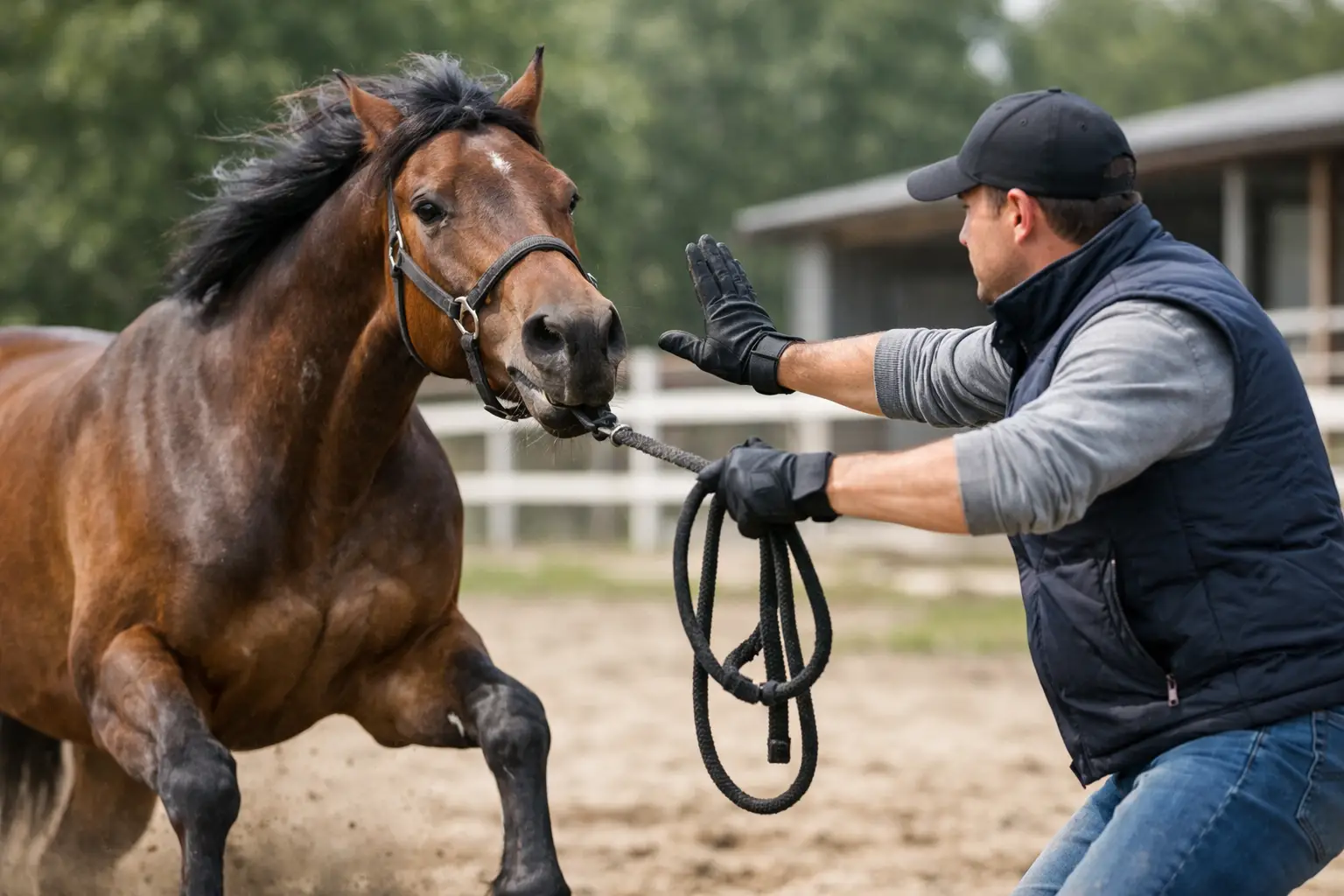
Leading in from the paddock. Opening a gate. Feeding. These should be the easy parts of your day — and if you've got a horse who barges, they're probably the moments you dread most.
Let's drop something right at the start: this isn't just a bad habit you're supposed to put up with. A horse moving you with his body is a safety issue. Full stop. It can also be a sign he's worried, rushed, or has simply learned that people step aside.
Here's what I want you to hear, though: you don't need to get loud, rough, or fearless to change this. You need a clear plan, consistent boundaries, and the honesty to get help before someone gets hurt. Barging isn't a character flaw in him, and it's not proof you've failed as an owner.
What Barging Actually Looks Like
It's not always dramatic. A shoulder swung into you while leading. Pushing past at a gate. Crowding at the feed bucket. Dragging you toward grass. The common thread is this:
he's making decisions about your space and movement, and you're the one forced to react.
If you find yourself constantly stepping back or sideways to get out of his way, he's probably learned that pressure on you works. And I want to be really clear — this happens with kind horses, quiet horses, horses you love dearly. It's not limited to "naughty" ones. A 500-kilo horse doesn't need bad intentions to hurt you badly.
Look for the Reason Before You Correct It
A horse who barges at feed time might be over-aroused by food. One who rushes gates might be anticipating turnout or his mates. One who leans heavily when led might simply never have had the groundwork education to know any different.
Pain is worth genuinely considering too, especially if this is new. Poor saddle fit, foot soreness, ulcers, dental discomfort — any of these can make a horse tense and less able to cope. A sudden change in manners deserves a proper check, not an argument in the yard.
And sometimes, honestly, the reason is simpler and a little harder to hear: he's practised this for a long time, because it's worked. People moved because they were afraid or distracted or carrying gear. Horses learn from what gets results.
Safety Comes Before Any of the Training
Please don't try to prove a point in a narrow race, on slippery ground, or when he's already wound up. Training isn't a contest — it should set you both up to succeed, not test how tough you are.
Your position matters more than most people realise. Leading from roughly beside his shoulder is generally safer than walking directly in front. Watch his whole body, beyond his face — the shoulder and feet usually tell you where he's about to go before his head does.
If he's ever knocked you over, dragged you, or become dangerous when corrected, please don't keep experimenting alone. Bring in an experienced professional who can watch both him and your handling in person. There's no prize for pushing through until your confidence disappears.
Here's the Habit Almost Nobody Talks About
I want to tell you something that surprises most owners: this usually isn't really about your horse being pushy at all. It's about one small, unconscious thing
you're doing — retreating, shortening the rope, turning your shoulder away the moment he leans in. He's not plotting anything. He's simply following the opening you keep giving him, without either of you noticing.
That one habit is exactly what I built
Claim Your Space to address — a short, focused mini course on the single most commonly missed handling habit behind pushy, unsettled horses. It's not about bullying him into place. It's about giving him a clearer, safer answer, consistently, until crowding simply stops making sense to him.
👉
Watch Claim Your Space for $27
Timing Matters More Than Force
Waiting until he's already on top of you means you're fixing the problem at its biggest possible moment. Watch for the first thought of barging instead — the ear locking onto the gate, the shoulder starting to drift, the walk quickening just slightly. Address that small change, and you'll rarely need a big correction at all.
The instant he yields or waits respectfully, soften and let the rope go quiet. That release is what actually teaches him. Constant pressure just creates a horse who leans, braces, or tunes you out entirely.
Practise the Moments That Usually Go Wrong
A horse can be beautifully mannered in the arena and still barge at the one gate leading to the paddock. That's not stubbornness — it just means the lesson hasn't transferred to real life yet.
Break it down. Walk toward the gate, stop before he rushes, ask him to wait. If he pushes ahead, quietly reset and try again — only open the gate once you can do it without him taking over your space. It'll feel slower at first. It's still faster than being dragged through a gate.
Consistency Without Becoming Punitive
One of the biggest mixed messages owners send is allowing a nudge or a crowd when they're relaxed, then getting cross about the exact same thing at an inconvenient moment. Horses don't understand that today you're tired or carrying a full feed bucket. They understand patterns.
That doesn't mean rigid or joyless — it means the boundary stays the same. He's welcome near you, just not through you. And please, try to avoid escalating out of embarrassment or fear. Yanking or yelling might stop him in the moment, but it can make an anxious horse more reactive, not less.
When Barging Points to Something Bigger
A barging horse isn't automatically the wrong horse — with the right support, most improve enormously. But I want you to be honest with yourself about the whole picture, too. If you're a nervous beginner or returning rider and this is happening regularly, frightening you at nearly every handling moment, that might genuinely be too much horse for where you are right now. That's not a shameful thing to admit. It's a safety decision, and a fair one.
Start small. Reward the right response quickly. Don't ignore the first signs. Every calm boundary you hold teaches him something worth knowing: you're predictable, his space is respected, and so is yours.