
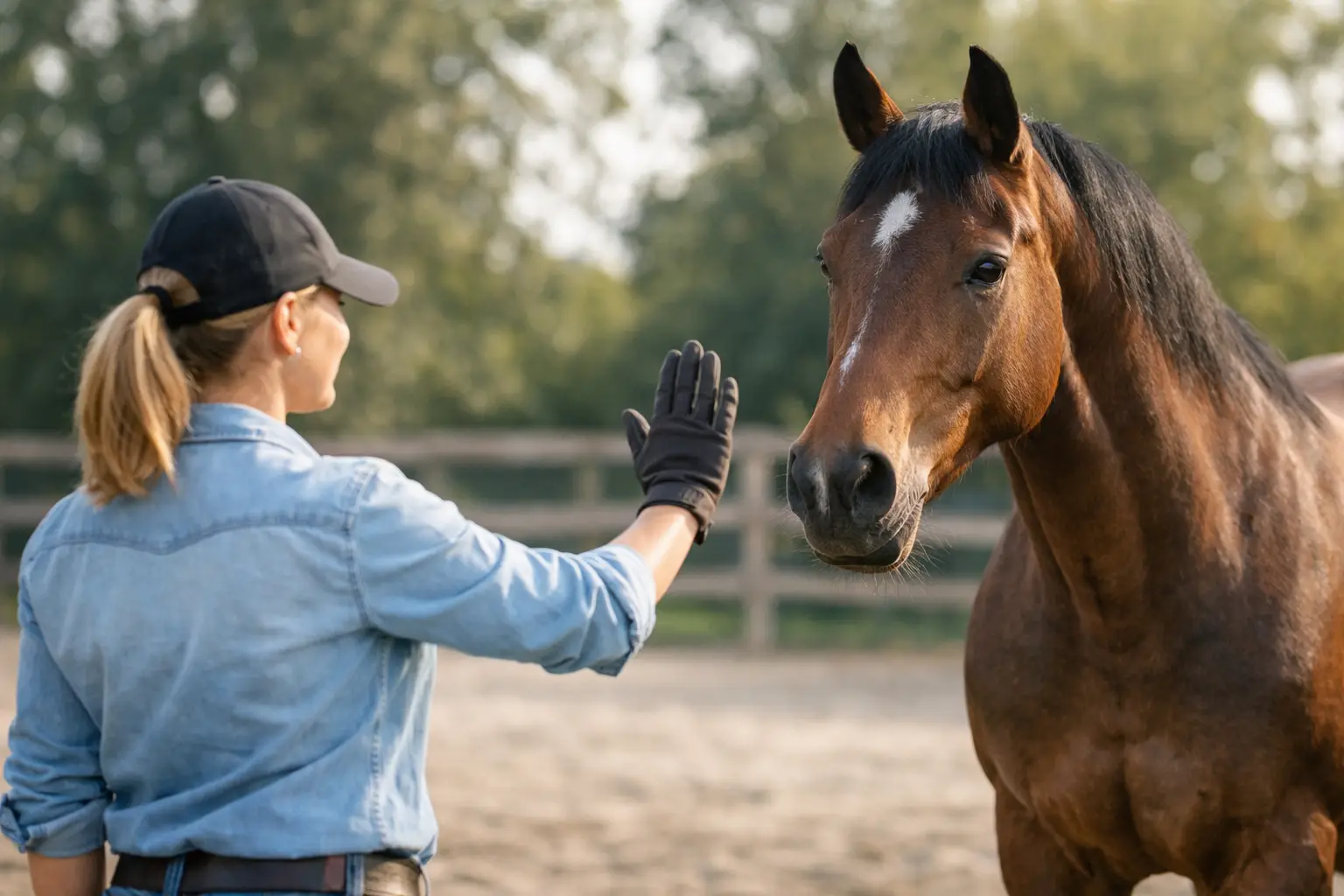
A horse that crowds you at the gate, leans into you while being led, or swings their hindquarters towards you is not being “affectionate” in a way you should simply tolerate. It may look harmless until you are pinned against a stable wall, stepped on, or dragged towards grass. Learning how to establish personal space with a horse is not about being harsh or trying to dominate them. It is about making your boundaries clear enough that your horse can relax, and you can handle them safely.
For many adult owners, this is where confidence starts to unravel. You may know your horse is not malicious. You may feel guilty correcting them. Perhaps someone has told you to be firmer, while someone else has told you to let them express themselves. Neither vague advice helps when you are standing beside a half-tonne animal that has learned to move you with their shoulder.
Why personal space matters to horses and handlers
Horses communicate largely through movement and pressure. In a herd, the horse that asks another to move their feet is creating space. That is not cruelty. It is clear communication, and horses use it constantly.
When your horse walks into your space, it does not automatically mean they are trying to be the boss. They might be anxious, itchy, food-focused, poorly educated, sore, overexcited, or simply used to people stepping out of their way. The reason matters, because a worried horse needs a different overall plan from a cheeky horse who has been allowed to barge through every gate.
But the immediate rule remains the same: your horse must not move your feet unless you have chosen to move. This is a safety boundary, not a personal insult to your horse.
A horse with good handling manners should be able to stand beside you without leaning, follow your pace without overtaking, and move away from light pressure. These basics matter on quiet days and matter even more when your horse is fresh, frightened, injured, or being handled by someone less experienced than you.
How to establish personal space with a horse safely
Start in a calm, familiar area with good footing. Avoid practising beside a feed bin, in a narrow tie-up bay, or near a busy gate where other horses are pushing about. Wear sturdy boots, gloves if you need them, and use a well-fitted halter with a lead rope that gives you enough room to work without wrapping it around your hand.
Your aim is not to chase your horse backwards across the yard. You are teaching a simple idea: when you ask for space, they respond promptly and calmly.
Begin with your own body position
Stand around an arm’s length from your horse’s shoulder, rather than directly in front of them or trapped at their side. Keep your shoulders up, look where you want your horse to go, and be deliberate about your feet. A surprising number of horses crowd people because the person handling them unconsciously gives ground first.
If your horse steps towards you, resist the urge to shuffle backwards. Instead, lift your energy slightly. Square your body, direct your focus towards the part of the horse you want to move, and ask them to step away. For the shoulder, this might mean raising your hand or lead rope towards the shoulder while maintaining a safe position. For the hindquarters, your body language should direct the hind end away, not invite it to swing into you.
The pressure should begin lightly. Horses deserve the chance to respond to a quiet request. If they ignore it, increase the pressure in a clear, fair progression until they take even one step away. The instant they move their feet in the right direction, soften. That release is what tells them they found the answer.
Ask for one good step, then let it mean something
One calm step back or sideways is enough at first. Do not keep driving just because the horse finally responded. Ask, receive, release. Repeating this pattern teaches your horse that moving out of your space is easy, predictable and pressure-free once they make the right choice.
If you keep escalating after they try, you risk making the horse defensive or confused. If you release before they move, you teach them that leaning or ignoring you works. Timing matters more than force.
Practise both sides. Horses can be noticeably less coordinated, less confident, or more resistant on one side. Do not assume that a horse who yields beautifully from the left understands the same request from the right.
Carry the boundary into everyday handling
Groundwork only works if it follows you out of the arena. At the gate, ask your horse to wait rather than crowding through. When leading, keep their shoulder beside or just behind yours, not ahead of you. If they surge past, calmly redirect them and continue. When grooming, do not allow them to swing their body into you because they want an itchy spot scratched.
You do not need to turn every interaction into a correction. In fact, constant nagging makes some horses tense and dull. Be clear when the boundary is crossed, then go back to being quiet. The goal is a horse who can stand comfortably near you, not one who looks worried every time you lift a hand.
What not to do when a horse crowds you
Do not try to win a pushing match. Leaning your body weight into a horse’s shoulder or shoving their chest may work on a quiet pony, but it is not a safe or reliable system with a larger horse. You will lose that argument if they decide to push back.
Avoid yanking, smacking in frustration, or swinging the lead rope without a clear purpose. These reactions can make an anxious horse more reactive and can teach a confident horse to brace against pressure. Fair consequences need to be immediate and understandable, not emotional.
Also be careful with treats. Food rewards can be useful in skilled hands, but if your horse already mugs pockets or crowds your chest, do not hand-feed while the manners are unclear. Reinforce calm behaviour from a safe position and make sure your horse understands that food never requires them to enter your space.
Most importantly, do not excuse dangerous behaviour because your horse is “just cuddly”. A horse can be loving, talented and genuinely sweet, and still have poor boundaries. Allowing crowding does not protect the relationship. It puts both of you at risk.
When crowding is more than a manners problem
If your horse has suddenly become pushy, look beyond training. Pain, ill-fitting tack, ulcers, hormonal changes, eyesight problems, restricted turnout, and stress can all change how a horse behaves around people. A horse that pins their ears, rushes at you, bites, kicks, rears, or repeatedly threatens you needs more than a few yielding exercises.
This is where owners can get into trouble by treating a serious behaviour issue as a simple respect problem. If you feel frightened, cannot safely hold the horse, or find yourself avoiding basic jobs such as catching, rugging or leading, get experienced help on the ground. There is no shame in that. The shame is often what keeps good people stuck in a risky situation for far too long.
Be honest about the horse in front of you as well. Some horses have gaps in their education that can be improved with consistent handling. Others are too anxious, too reactive, or simply too much horse for their current owner. Love does not change the practical question of whether you are safe and supported.
Build confidence through consistency, not bravado
Personal space is not established in one dramatic session. It is built through dozens of small moments where you stop moving out of the way, ask clearly, and reward the right response. Your horse learns that you are predictable. You learn that you do not have to become loud, tough or aggressive to be effective.
If this is a pattern you are struggling to shift, it can help to have an experienced set of eyes identify the small habits that are accidentally inviting your horse into your space. Often, the fix is simpler than owners expect, but it needs to be applied consistently before the old habit becomes the new normal.
Your horse does not need you to be perfect. They do need you to be clear. A calm boundary gives them an answer they can trust, and gives you room to enjoy the partnership without always wondering whether the next step will be yours or theirs.
