
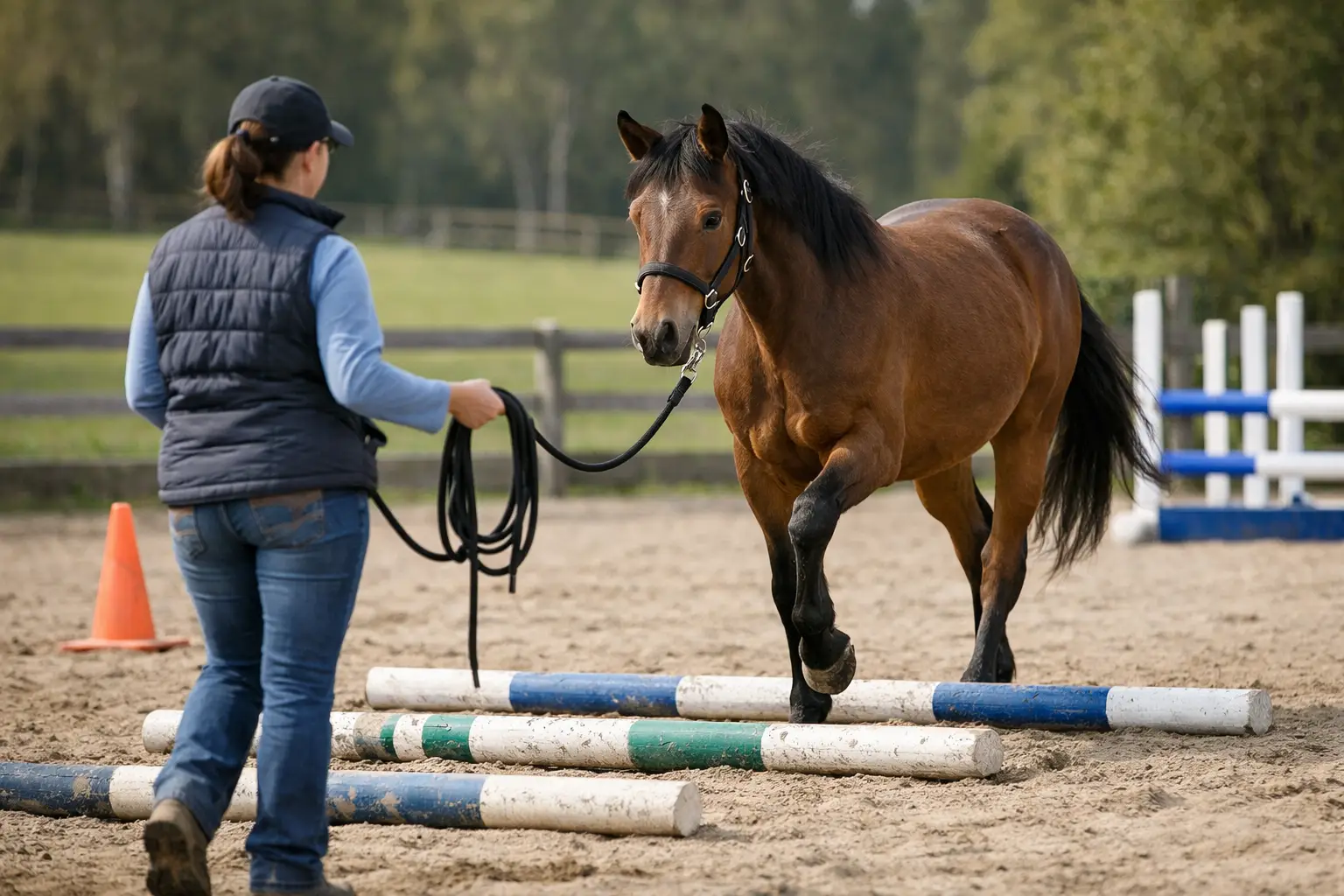

He was quiet in the stable. Lovely over a fence. Perfectly mannerly while his old owner held the rope.
Then he arrived at your place, and something shifted. New smells, new routines, a new person asking questions — and suddenly you're standing there wondering who this horse actually is.
That's the real point of groundwork in those first weeks. Not performance, not proving who's boss. It's a conversation — one of the only ways you actually get to meet the horse standing in front of you, rather than the version who was on his best behaviour for the sale.
You're Not Testing Him. You're Meeting Him.
A horse that barges, freezes, or can't settle in a new place isn't being naughty. He's telling you something about how he copes with pressure and uncertainty — and that's information worth having before you ever put a foot in the stirrup.
Give him time first. Let him eat, drink, and take in his surroundings before you go looking for a bond. Rushing to "connect" in the first few days usually tells you more about your own excitement than about him.
Work somewhere enclosed and quiet, with as few distractions as you can manage. Keep sessions short — ten calm minutes that end well teach you more than forty minutes after he's mentally checked out. And watch the whole horse as you go: his eye, his jaw, his breathing. A horse can comply with a request while still being frightened underneath it. That's not the relaxed, trusting animal you're actually trying to get to know.
What Standing Still Together Actually Tells You
The simplest groundwork moment — just standing quietly side by side — isn't really about teaching him to stand still. It's a read on whether he can settle near you, specifically, without leaning, scanning or bracing.
Some newly arrived horses stay alert for the first few days, and that's understandable. What matters more is the trend: is he settling into you a little more each session, or is standing near you something he seems to tolerate rather than choose?
Leading Is a Conversation About Trust, Not Control
When you walk together, you're not trying to march him around on a tight rope. You're noticing whether he checks in with your direction, or whether he's used to people simply getting out of his way.
A horse that surges past you or leans on the lead isn't automatically being difficult — he might be anxious, sore, or genuinely never taught to consider where you are. But don't excuse it as "just friendly," either. How he handles your space in week one tends to be a fairly honest preview of how he'll handle it in month six.
Here's the part most new owners never get told: barging and crowding almost always trace back to one small, unconscious habit on the human end of the rope — a tiny shift you're making without realising it, every single time you step aside to make room. Fix that one habit, and the pushiness tends to unravel fast. Louise breaks down exactly what it is, and how to reverse it before your next paddock visit, in Claim Your Space.
👉 Watch Claim Your Space for $27
The Small Exercises Matter Less Than What They Reveal
A halt-and-back-up. Yielding the hindquarters a step. Moving the shoulder over at a gate. None of these are really about drilling a skill — they're small, low-stakes questions you're asking him, one at a time: Can you soften here? Do you trust me to release the pressure? Can we find an answer together without a fight?
Watch for the difference between a horse who tries something, gets it a little wrong, and settles — versus one who braces, panics, or shuts down entirely. That difference tells you far more about the relationship ahead than whether he technically performed the exercise correctly.
The same goes for introducing something ordinary and new — a jacket, a wheelbarrow, a hose. The useful question was never "will he spook?" Every horse spooks. It's "how quickly can he recover, breathe, and come back to me?" Recovery, not perfection, is what you're actually watching for.
What You're Learning About Yourself, Too
Groundwork isn't a one-way assessment. If you notice your own shoulders tightening every time you pick up the lead rope, that's worth taking seriously too. A new partnership is built from both directions — his willingness to trust you, and your ability to stay calm and clear enough to be trustworthy in return.
That mutual read — not a checklist of tricks — is what actually determines whether the first few weeks build a foundation or a series of small conflicts neither of you enjoys.
You Don't Have to Work This Out Alone
The quiet, ordinary moments — a soft breath beside you, one foot moved when asked, both of you a little calmer at the end of a session than the start — are where a safe partnership actually begins. But knowing how to read those moments, what's a normal settling-in wobble versus something that needs a professional eye, and how to build genuine trust without accidentally teaching the wrong lesson, is exactly the gap that catches new owners off guard.
That's precisely what Louise Kropach built the New Horse Owner Survival Guide to cover — not just groundwork, but the safety fundamentals, the "is this an emergency" judgment calls, and the daily care confidence that turns those first overwhelming weeks into ones you actually enjoy.