
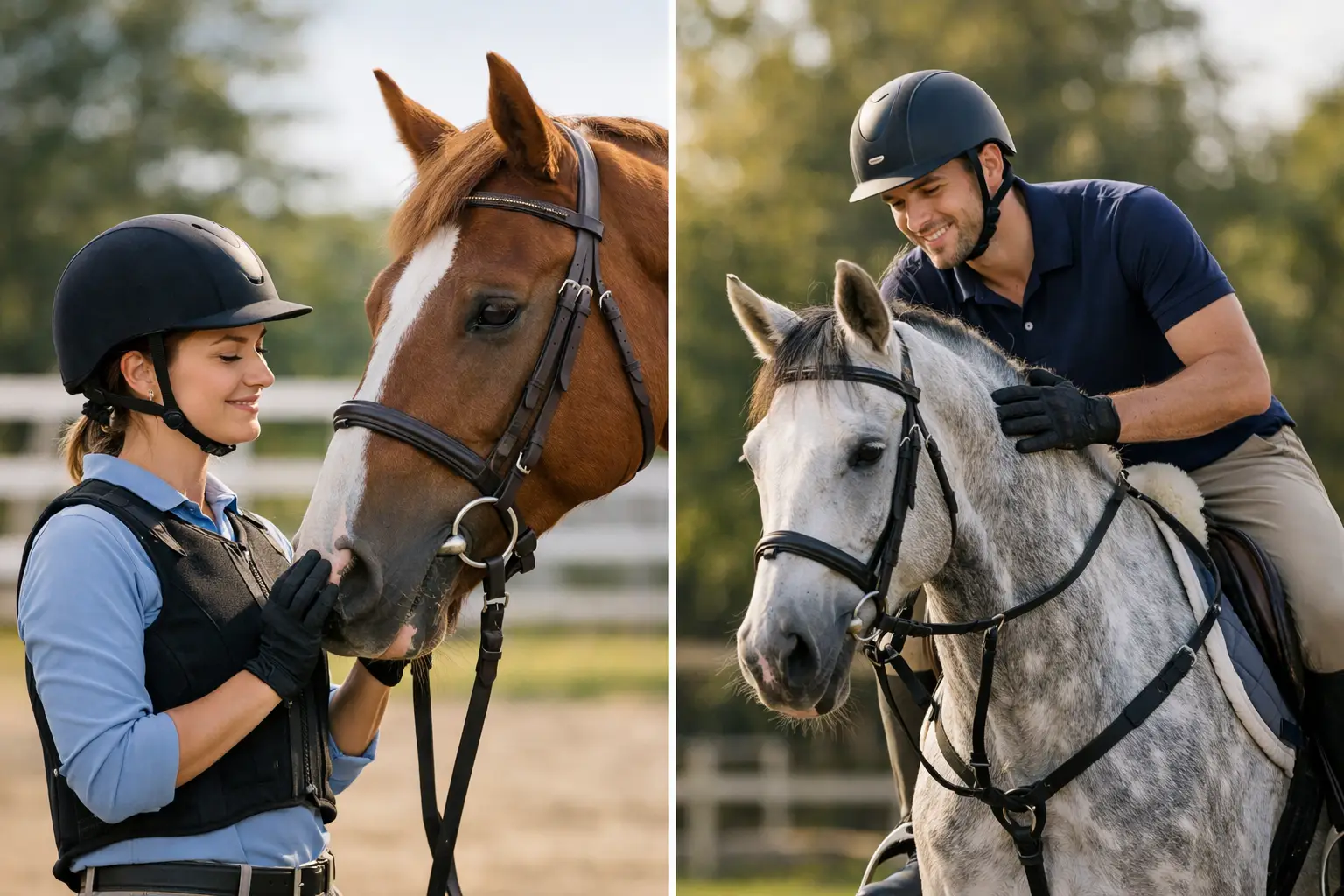

He's standing there quietly for a photo, looking gorgeous in the yard, and I need to tell you something: none of that tells you if he's right for you.
I say this to riders all the time — temperament isn't a bonus feature you weigh up after colour and movement. It's the thing that actually decides if you feel safe enough to enjoy him. I've watched so many riders fall for a horse in ten minutes flat, then spend months, sometimes years, trying to force that match to work. That doesn't make them foolish. It makes them human. But wanting something badly has never once made it suitable.
Let's Talk About What Temperament Actually Is
When I say temperament, I mean his usual way of responding to people, pressure and change. How fast he reacts. How hard he reacts. Whether he can actually think when something worries him. Here's the trap I see buyers fall into constantly: a forward horse isn't automatically dangerous, and a quiet horse isn't automatically safe. The question I want you asking is whether his natural responses are manageable for you, in the life you'll actually give him — not the life you're hoping to have in six months. Some horses are sensitive but honest with it. They notice everything, then look straight back to you and settle fast. Others seem perfectly quiet right up until they're asked to leave the property, or cope with a rider who's a little unbalanced. That's exactly when the real horse shows up.Here's the One Thing I'd Watch For Above Almost Everything Else
I don't need a horse who never has a moment. Nobody does. What I need to see is recovery. Say a bird flies out of a hedge and he startles. Fine — that's just being a horse. What actually matters is whether he takes a breath and comes back to you, or stays wound up for the next twenty minutes. Honestly, I'd rather have a horse who spooks and recovers in five seconds than one who's simply never met anything challenging yet. I'd also want him to forgive your bad days. You'll drop a rein sometimes. You'll lose your balance, get a bit nervous. A kind horse doesn't need perfect handling to stay safe with you. If he escalates every single time you're not precise, I'd be honest with you — he might be too much horse for where you're at right now.Don't Skip Over His Ground Manners
Here's something I wish more buyers understood: a horse who drags you, leans on you, or barges through gates isn't being affectionate. He might be anxious. He might just be used to taking charge because nobody's ever asked him not to. I care about this a lot, because how he handles pressure on the ground tells me almost everything about how he'll handle it under saddle. They're not two separate conversations.Watch Him Before Anyone Tells You a Story About Him
I'm not saying sellers lie to you. Most genuinely believe their horse is quiet — they've just managed his tension so smoothly, for so long, that they don't even see it happening anymore. My job when I go and look at a horse isn't to accuse anyone of anything. It's to watch closely enough to protect myself. If you can, get there early and watch him come in from the paddock before he's prepped for you. Watch the person handling him too — are they calm, or are they constantly correcting and making excuses before anything's even happened? A few things I'd personally be watching for:- Does he crowd at the mounting block?
- Does he actually stand while the girth's done up?
- Are his ears, eyes and body genuinely soft, or is he tight through the jaw and back?
Now Let's Talk About You
This is the part buyers skip, and I get why — it feels a bit exposing. But the right horse isn't the one another rider calls easy. It's the one whose energy actually suits your current skills and the support you've got around you. I want you to be honest with me about the version of you who'll handle him on an ordinary Wednesday. Not the version who rode brilliantly at a clinic once. I mean the rainy morning, alone, short on time, after he's had a few days off. Could you bring him in and tack up without feeling frightened? If you hesitated even a little answering that, I'd want to know why.What If He Was Fine and Then He Wasn't?
Sometimes a horse genuinely seems right at purchase, then gets difficult a few months in. Please don't jump straight to blaming yourself, and please don't decide he's simply turned nasty on you. I always look at pain first, especially if the change is sudden or tied to saddling or being touched in a particular spot. Teeth, feet, saddle fit, ulcers — any of it can shift how a horse copes. I'd rather investigate properly than discipline a horse through something he can't control. And if he's become pushy on the ground, I really don't want you brushing that off as cheekiness. Teaching him to respect your space, calmly and consistently, is a safety matter to me — not a battle of wills.The Questions I'd Actually Ask
Before you hand over any money, here's what I'd want answered directly: How long has the current owner had him? What's he like after time off? Has anyone come off him, and what happened right before it? Listen closely to how specific the answer is. "He can be a bit cheeky" tells me nothing on its own — it could mean anything from a minor boundary test to something genuinely unsafe. I'd ask what that actually looks like in practice, and how often it shows up.Here's Where Most Buyers Get Stuck
Knowing what to look for is honestly only half the job. Turning what you see in one viewing into real evidence — reading his recovery correctly, asking the follow-up question that exposes a vague answer, matching all of it to your actual life rather than the one you're hoping for — that's where I see even careful buyers lose their nerve or talk themselves out of what they saw. That's the whole reason I built The True Match™ Guide the way I did — I walk you through that entire process step by step, with a printable checklist you can genuinely bring to every viewing. The best horse was never the one who made your heart race the moment you met him. It's the one who lets you breathe, learn, make the occasional mistake, and build something that feels a little safer every time you're together.💛 The True Match™ Guide — $27
A complete, step-by-step framework for reading a horse's real temperament before you buy — covering the exact recovery signs to watch for, the follow-up questions that expose a vague answer, and a printable checklist to bring to every viewing. Backed by a 30-day, love-it-or-it's-free guarantee. 👉 Get The True Match™ Guide Here