
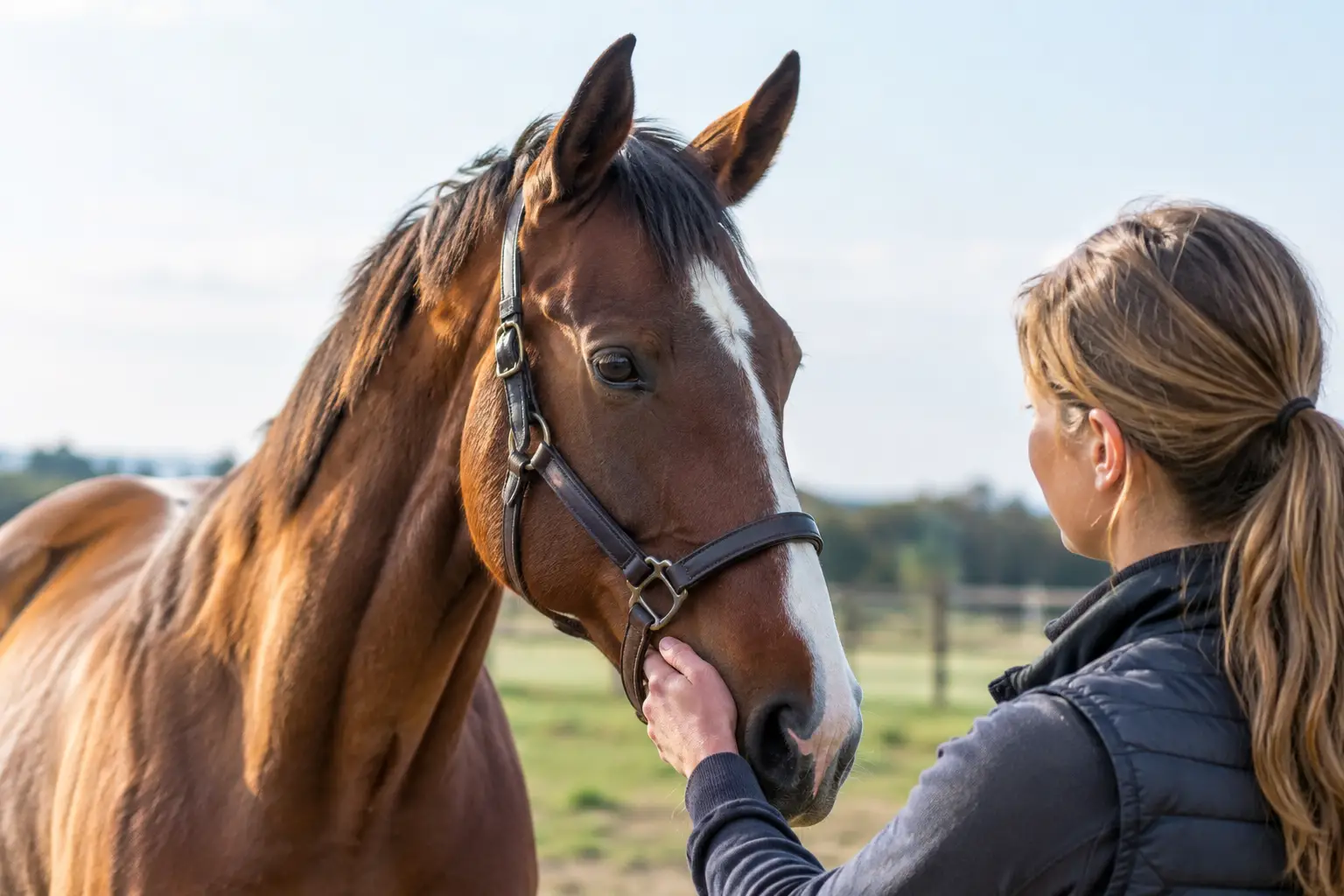
A horse rarely starts with a big reaction. Before the spook, the bolt, the bite, the refusal to load or the sudden ‘bad behaviour’, there is often a quieter message: a tight mouth, a fixed stare, a tail that will not settle, feet that cannot stop moving. Learning how to read horse stress means noticing those messages while your horse is still asking for help, not waiting until they feel they have to shout.
This matters whether you own the horse, ride at a lesson barn, or are looking at a horse to buy. Too many riders are told a worried horse is simply ‘fresh’, ‘cheeky’ or ‘testing boundaries’. Sometimes a horse does need clearer handling. But stress is not badness, and punishing a horse for being overwhelmed can turn a manageable concern into a safety problem.
How to read horse stress without guessing
Start by looking for a change from that individual horse’s normal behaviour. There is no single sign that proves a horse is stressed. One horse may paw when worried; another becomes very still. A naturally alert Thoroughbred will not look the same as a sleepy school pony. Context matters.
Ask yourself three plain questions: What has changed? What happened just before it changed? Does the horse settle when the pressure is removed or understood?
For example, a horse who lifts their head when another horse calls out may simply be alert. A horse who stays rigid, braces through the neck, stops chewing, rushes their feet and cannot reconnect with you is telling a different story. The first is information. The second is rising stress.
Do not make a judgement from one ear flick or one swish of the tail. Read the whole horse, then watch for patterns. The best horse people are not mind readers. They are patient observers who stop making excuses for signs that keep repeating.
Start with the face, neck and breathing
The face often gives you the earliest useful clues. Watch the eye. A worried horse may show a tense, wide or fixed eye, with visible white in some cases. But white of the eye alone is not a verdict. Some horses naturally show more sclera because of their conformation or where they are looking.
Look at the muscles around the eye, nostril and muzzle. Tightness through the muzzle, pinched nostrils, a clenched jaw or lips pressed hard together can suggest discomfort or concern. So can a horse that suddenly stops blinking or chewing when something becomes difficult.
Then look up the neck. A horse carrying their head high with a rigid underside of the neck is often braced for action. A neck stretched forward and down can indicate relaxation, but only if the rest of the body softens too. Do not be fooled by a horse forced into a low outline while their tail is clamped, back is hollow and steps are hurried.
Breathing is another clue riders miss. A horse may breathe faster after work, of course. What deserves attention is rapid, shallow breathing that does not match the workload, or a horse holding their breath during handling, tacking up, mounting or a particular exercise.
The feet tell you whether stress is building
Horses move their feet when they are uncertain. That does not automatically mean danger, but it is a conversation worth listening to.
A stressed horse may jig on the spot, circle their handler, rush forward, drift towards the gate, plant their feet, paw, rock back and forth, or repeatedly change weight from one leg to another. Some horses try to leave. Others freeze. Both can be signs that their nervous system is overloaded.
Freezing is especially easy to miss because it can look like obedience. A horse standing very still with a hard eye, locked body and little response to their handler is not necessarily calm. They may be bracing. If you keep increasing pressure because they have not moved, you can push them from freeze into an explosive reaction.
When you see feet becoming busy or stuck, make the task smaller. Give the horse room to process. Slow down your own body, check that your request is clear, and avoid trapping them between pressure from your hand, leg, whip, fence or another person. Safety comes first, so do not stand in front of a horse that is threatening to barge or bolt. Create space and get capable help if you need it.
Stress can look like ‘naughty’ behaviour
Tail swishing, ear pinning, biting at the girth, kicking out, refusing to go forward and rushing can all be blamed on attitude. Sometimes a horse has learned that pushy behaviour works. Sometimes the horse is frustrated by inconsistent boundaries. But pain, fear, poor saddle fit, ulcers, dental trouble, lameness, hormonal changes, lack of turnout and an unsuitable workload can also sit underneath the behaviour.
This is where honest horsemanship matters. If a normally willing horse changes suddenly, becomes girthy, threatens when mounted, bucks, stops at jumps, resists a lead, or cannot settle where they once could, do not simply train harder. Rule out physical discomfort with the appropriate qualified professionals.
A horse can also be stressed because they are being asked to do more than they understand. A green horse in a busy arena, a returning rider gripping through every stride, or a sensitive horse passed from handler to handler may not be ‘too much horse’ by nature. The situation may be too much right now.
That said, repeated stress behaviour is still a real safety concern. Compassion does not mean pretending you can safely manage a horse that regularly overwhelms you. You can care deeply about a horse and admit the partnership needs more support, a different plan, or a different home.
Watch the whole picture around the horse
If you want to understand stress, stop watching only during the ride. Notice your horse being caught, led, groomed, fed, turned out, brought in, tied up, rugged, floated and left alone. A horse who is quiet under saddle but panics at the float is still struggling somewhere. A horse who is easy to catch but becomes tense as soon as the saddle appears is giving you valuable information.
Keep a simple record for a couple of weeks. Note what happened, where it happened, who was handling the horse, what their body did, and how long it took them to settle. Patterns become much clearer when you stop relying on memory after a difficult day.
Pay attention to the environment too. Heat, flies, wind, unfamiliar horses, limited forage, a change in routine, noisy machinery and tight stabling can all lower a horse’s tolerance. You may not be able to remove every stressor, but you can avoid piling demands on top of an already worried horse.
What to do in the moment
When you spot early stress, your job is not to win an argument. Your job is to restore enough safety and clarity that the horse can think again.
First, lower the pressure where it is safe to do so. That may mean stepping away from the scary corner, pausing the grooming, returning to an easier exercise, giving the horse more personal space, or ending a session before it becomes a fight. Lowering pressure is not the same as letting a horse drag you around or invade your space. Clear boundaries and calm handling can sit together.
Next, give the horse one simple task they understand. On the ground, that could be standing quietly a few steps away, walking a small calm circle, or yielding a step from light pressure. Under saddle, it may mean a quiet transition, a familiar bend or a walk break. Keep your request small enough that success is possible.
Then reassess. Has the eye softened? Has the breathing steadied? Are the steps more regular? Can the horse respond without rushing or shutting down? If not, do not keep escalating because you had a plan for the session. The plan can change. The horse in front of you is the one that matters.
Reading stress when you are trying a horse to buy
A sale viewing is one of the easiest places to misread stress because everyone wants the horse to look good. You may see a polished ride in a familiar setting, then feel rushed to make a decision while your heart is already attached.
Watch how the horse responds before they are ridden. Notice the catching, grooming, saddling, mounting and handling around other horses. Ask to see them in more than one situation where possible, and take note of whether they settle after a moment of concern or grow more reactive as pressure builds.
A tense horse is not automatically a bad horse. But a horse that regularly looks worried, shuts down, barges, rushes or reacts beyond your skill level is not a small detail to explain away. A beautiful horse can still be the wrong match. Walking away can protect your confidence, your bank balance and the horse from being placed with someone who cannot safely help them.
Your horse does not need you to be perfect. They need you to pay attention early, stay honest about what you are seeing, and seek help before fear becomes the language they use most loudly.