
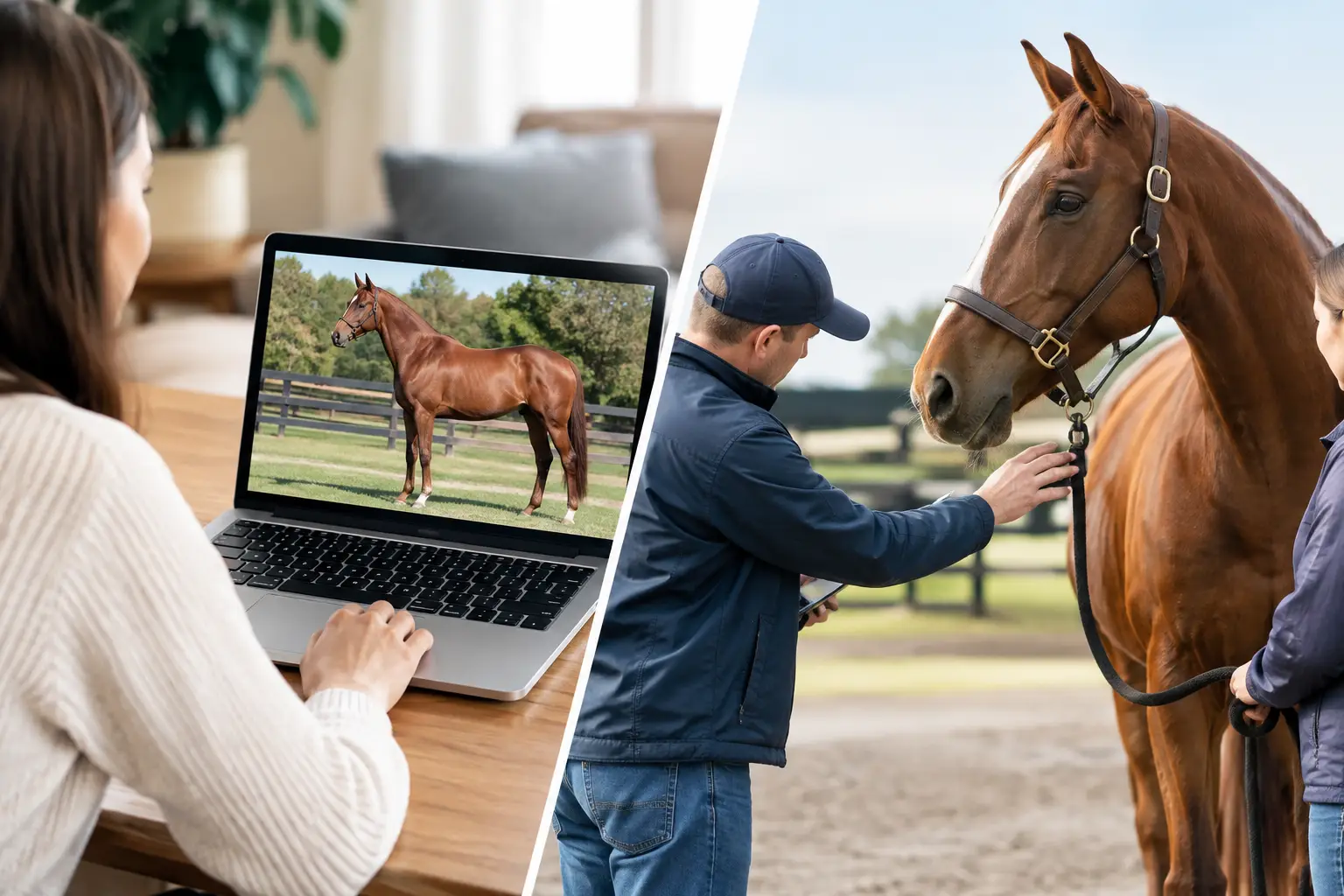
A polished sale video can make a horse look like the answer to your prayers. They are quiet while being tacked up, soft in the bridle and apparently happy to carry their rider past a few jumps. But online viewing versus inspection is not a choice between two equally reliable ways to assess a horse. One is a useful first filter. The other is where you find out whether the horse is truly safe, suitable and honestly represented.
That distinction matters because a wrong horse can cost far more than the purchase price. It can take your confidence, create fear around riding, strain your finances and leave both you and the horse in an unfair situation. A beautiful video is not evidence of a good match.
What an online viewing can tell you
Online adverts, photos and video are valuable when you use them for what they are: an introduction. They can help you decide whether a horse is worth travelling to see, especially when the horse is interstate or several hours away.
A longer, unedited video may give you a sense of the horse's way of going, basic education and physical presentation. You may see whether it looks comfortable at walk, trot and canter, whether it is being ridden in an arena or out on a trail, and whether the rider appears to be constantly managing it.
Pay attention to the moments sellers often leave out. Does the video begin with the horse already warmed up? Is every clip only a few seconds long? Is the horse shown only under a very capable rider? A horse can look steady with a confident professional and feel like far too much horse for a returning rider.
Ask for recent footage rather than relying on a highlight reel from last season. Ask to see the horse caught in the paddock, led, groomed, rugged, tacked up, mounted and ridden from both sides. You are not trying to catch someone out. You are trying to see the ordinary handling moments that shape daily life with a horse.
What the camera can hide
A video has a frame, and someone else chooses what sits outside it. It may not show a horse that barges when led, pins its ears at feed time, needs a strong handler, becomes anxious away from other horses or is difficult to load.
It also cannot tell you how the horse feels in person. You cannot feel whether it leans heavily on the rein, rushes its transitions, ignores the leg, becomes tense when you shorten the rein or changes completely when a novice rider gets on. Those details are not small. They are often the difference between a rider progressing with confidence and a rider becoming frightened.
Then there is the horse's environment. Some horses are settled in their familiar arena with their usual rider, but become reactive when taken to a new property, asked to work alone or handled by an unfamiliar person. That does not make them bad horses. It does mean their real needs may not match the life you can offer.
Be wary of claims such as “bombproof”, “anyone can ride” or “no vices” when there is little clear footage to support them. Honest sellers can still have blind spots about their own horse. Sales language is not a temperament assessment.
Online viewing versus inspection: use each for its job
Treat online viewing as the screening stage. If the horse looks promising, the communication is open and the price, age, height and experience suit your plan, arrange an inspection. If the seller avoids straightforward questions, refuses to provide current footage or pressures you to pay a deposit before you have done your homework, walk away.
An in-person inspection is not simply a chance to sit on the horse and see if you like it. It is your opportunity to observe the whole picture. Arrive with enough time. Do not accept a rushed visit where the horse is already tacked up, warmed up and waiting at the mounting block.
Watch the horse before anyone tries to impress you with it. Notice its expression, attention, manners and response to the handler. Is it relaxed, or shut down? Does it respect personal space? Does it pull, crowd, swing its hindquarters or become difficult around routine requests? One awkward moment does not automatically rule a horse out, but patterns matter.
Ask the seller to handle and ride the horse first. Then ask to see the situations relevant to the job you need the horse to do. If you want a quiet trail companion, watching it school a neat circle in an arena is not enough. If you want to compete, a casual plod around the property tells you very little about its education and mindset at an event.
Ride for information, not for a sale photo
When it is your turn to ride, give yourself permission to take it slowly. You do not need to prove you are brave, capable or worthy of the horse. A sensible seller will understand if you want to begin in walk, ask simple questions and stop if you do not feel safe.
Notice how much support the horse needs to remain calm and responsive. Does it stand quietly at the mounting block? Does it move away from your leg without rushing? Can you steer, stop and regulate the pace without an argument? Is it forgiving when your aids are imperfect?
A horse does not need to be push-button to be a good match. Few are. But a first-time owner, nervous rider or rider rebuilding confidence does not need a project disguised as potential. If you are thinking, “I am sure I will get used to it,” pause. You may get used to a horse. You cannot safely wish away a serious mismatch in strength, confidence or experience.
If possible, have an experienced, independent person with you. Choose someone who understands your riding, not someone who is dazzled by a flashy mover or a bargain price. Their job is not to decide for you. Their job is to help you notice what emotion may be encouraging you to overlook.
Questions that deserve clear answers
Before and during the inspection, ask about the horse's daily routine, turnout, feed, farrier schedule, health history, workload, transport, behaviour away from home and reason for sale. Ask what the horse finds difficult, not only what it does well.
Listen carefully to how the answer is given. “He can be a bit cheeky” can mean anything from a harmless test of boundaries to a horse that becomes dangerous when challenged. Ask for a recent example, what happened, who was riding or handling him, and how it was resolved.
It is also reasonable to ask whether the horse has been ridden by people similar to you. Height and age are not enough. A petite, experienced rider may be entirely comfortable on a forward horse that would overwhelm a larger but less confident adult. Suitability is about skill, feel, confidence, goals and the support around you.
A pre-purchase veterinary examination should be part of the process once you are serious. It cannot guarantee a horse will never go lame or develop a problem, but it gives you information to make a clearer decision. Choose a vet who is independent of the seller and be honest about what you intend to do with the horse.
Do not let urgency make the decision
The most expensive mistakes are often made when someone feels they must decide immediately. Perhaps the horse is popular, another buyer is supposedly on the way, or you have been searching for months and are tired of looking. Those feelings are real, but they are not a reason to skip an inspection or ignore discomfort.
A suitable horse will still need to suit you after the excitement settles. Sleep on it. Write down what you saw, what you felt and what questions remain. Compare the horse with the practical life you can provide, not the dream version of horse ownership you hope will appear once you bring it home.
If you are unsure what to watch for, get guidance before money changes hands. A few grounded questions early can protect years of riding confidence and help you avoid asking an unsuitable horse to become something it is not.
The right horse does not have to be perfect. It does need to leave you feeling safe enough to learn, clear enough to make a fair decision, and hopeful about the partnership you are building together.