
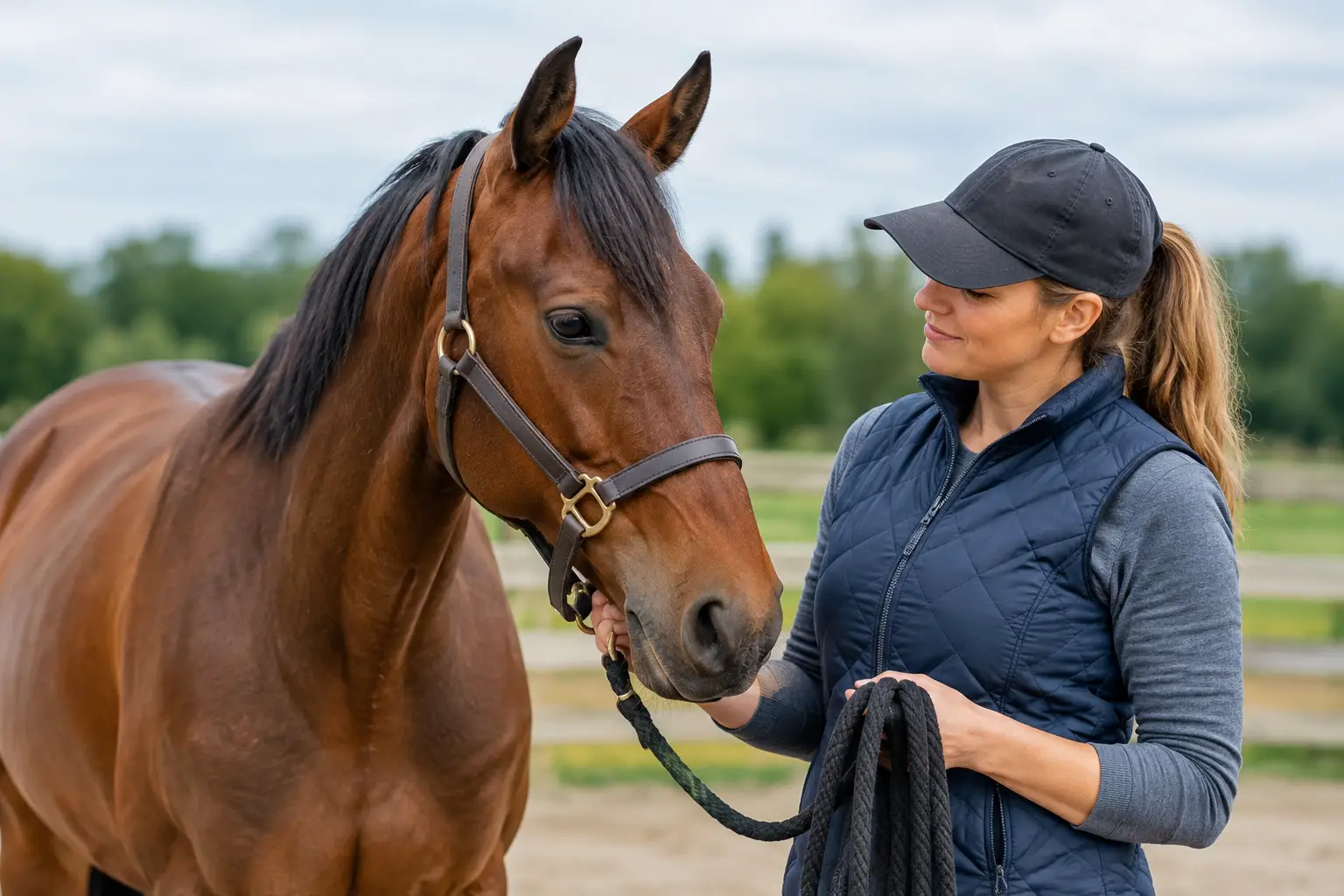
A horse does not need to be openly aggressive to be unsafe to handle. The horse who drifts into your space at the gate, drags you towards grass, swings their hindquarters as you rug them, or plants their feet when you need to move is already telling you something. Safe horse handling tools can make everyday jobs safer, but only when they support clear handling rather than cover up a problem.
That distinction matters, particularly if your confidence has taken a knock. It is easy to buy another piece of gear when you feel out of control. But no halter, lead rope or whip can replace safe positioning, timely pressure and release, and the ability to notice when your horse is becoming worried, pushy or too much for you to manage alone.
What safe horse handling tools are really for
Good handling equipment gives you a practical margin of safety. It helps you keep a respectful distance, maintain a secure connection and avoid putting your hands or body in a dangerous position. It should be suited to the job, fit the horse correctly, and be familiar enough that you can use it calmly.
It is not there to overpower a horse. If you regularly need stronger equipment simply to lead, catch or stand near your horse, do not brush that aside as a gear problem. It may be a training issue, pain issue, management issue, or a sign that this horse is currently beyond your skill level. That is not a failure. It is useful information, and it is far safer to face it early.
The safest handlers I know do not collect harsh tools. They build habits: they assess the horse in front of them, set clear boundaries before things escalate, and know when to step away or ask for experienced help.
The essential safe horse handling tools
You do not need a shed full of gadgets. Start with equipment that protects you, gives clear communication and is appropriate for ordinary handling.
- A properly fitted halter should sit clear of the horse's eyes and not hang so loosely that it twists or catches. A well-fitted leather or breakaway option can be sensible for tying situations, depending on how and where you handle your horse. Never leave any halter on in the paddock unless there is a specific, professionally managed reason.
- A sturdy lead rope gives you enough length to stay out of the horse's immediate space without creating loops around your hands. Choose one that feels secure in your grip and is free of worn clips, fraying or stiff, damaged sections.
- Enclosed boots and gloves are basic protection, not an admission that you expect trouble. Boots with a solid toe and a secure sole protect your feet when a horse steps sideways. Gloves can prevent rope burn, although they do not make it safe to wrap a rope around your hand.
- A helmet is wise whenever there is a realistic chance of being knocked, pulled over or struck, such as handling a young, unfamiliar or unsettled horse. Adult riders sometimes resist this because they feel they should be more capable. Capability does not make a head injury less serious.
- A training stick or long dressage whip can extend your arm for groundwork, asking a horse to move away from your space without you standing in the kick zone. It is a communication aid, not a punishment tool. If its presence makes your horse fearful or explosive, get skilled guidance rather than insisting they must just accept it.
A rope halter may offer more precise pressure than a flat halter, but it is not automatically safer. In uneducated hands, any halter can become a means of pulling, hanging on or escalating a frightened horse. Similarly, a chain lead may be appropriate under professional direction for a particular horse, but it should never be the first answer to poor leading manners. Stronger equipment can hide the fact that the handler has no clear plan once the horse reacts.
Check the gear before you check the horse
A cracked clip, loose buckle or lead rope that is about to break is a small issue until it fails at the wrong moment. Before bringing your horse in, take ten seconds to check the halter, clip and rope. Make sure your boots are done up, your gloves are on if you use them, and your mobile is not in the hand holding the lead.
Also look at the environment. Slippery concrete, a narrow breezeway, an open gate, loose dogs, feed buckets and a horse tied where another horse can crowd them all change the risk. Safe handling is not just what you hold. It is where you stand and what you have allowed to build around you.
Your body position is the tool most people overlook
A horse can be affectionate and still be dangerous if they have learned to lean, crowd or barge through people. Many owners unintentionally teach this by stepping back every time the horse steps forward. The horse learns that your space belongs to them.
When leading, aim to be beside the horse's shoulder, not directly in front where you can be run over, and not so far behind that you are beside the ribs or hindquarters. Keep a sensible amount of rope between you and the clip. Fold the excess neatly in your hand if needed, but never coil it around your hand, wrist or waist.
Your job is not to march a horse from A to B while hoping they behave. Your job is to notice whether they can walk with you, stop when you stop, and stay out of your space without being constantly corrected. If they cannot, slow the process down. Ask for one quiet step, then another. A horse that is rushing, staring, jig-jogging or bracing is not ready for a bigger ask just because you are late for a lesson or trying to get chores finished.
Do not get trapped by politeness
There is a particular kind of owner who is endlessly patient with their horse and hard on themselves. They excuse the nudge, the shoulder barge and the tail swish because they do not want to be "mean". Clear boundaries are not mean. They are fair.
Horses feel safer when the person handling them is predictable. You can calmly ask a horse to step back, move their shoulder away or wait at a gate without picking a fight. The release is as important as the request. Apply only enough pressure to ask, then soften the moment the horse makes an effort. That is how a horse learns without being frightened or nagged.
Tools cannot fix a horse who is worried or in pain
If a usually cooperative horse suddenly becomes difficult to catch, pins their ears while being rugged, bites when you do the girth, or refuses to lead away from companions, do not assume they are being naughty. Behaviour changes are information.
Check for pain, discomfort, changes in feed or turnout, herd stress, saddle fit concerns and inconsistencies in handling. A horse who feels trapped or sore may react fast, and a stronger lead rope will not solve the reason behind it. Your vet, qualified bodywork professional, farrier, dentist or experienced trainer may each have a place in working out what has changed.
There is also a welfare issue here. A frightened horse being repeatedly hauled, cornered or punished can become more defensive. You may win a moment of compliance while losing the horse's trust and increasing the danger next time.
When to stop and get help
Walk away from the idea that every handling problem should be solved by sheer determination. You need support if your horse has knocked you over, rears while being led, regularly drags you, strikes, bites, kicks, or becomes dangerous around feed, gates or other horses. The same applies if you are beginning to dread catching them or feel sick before going to the paddock.
That feeling is not something to push through alone. It is your nervous system recognising that the situation is not safe. A capable professional can observe the small moments that are easy to miss when you are emotionally invested: where the horse starts to take over, where your timing changes, and whether the horse is showing fear, pain or learned pushiness.
If you are considering buying a horse, watch how they are caught, led, tied, groomed and moved through gates before you fall in love with the ride. A calm demonstration from an experienced handler is useful, but it is not enough. You need to see whether the horse can be handled quietly by you, with appropriate supervision, and whether their behaviour matches the seller's story. A horse that is too much horse on the ground is not made safe by a new halter.
The right tools should leave you feeling more organised, not more reliant on force. Start with sound gear, safe footwear and a clear understanding of personal space. Then pay attention to the horse in front of you. The safest choice is often not buying something stronger. It is pausing early, getting honest help, and refusing to let a small warning sign become the moment that costs you your confidence.