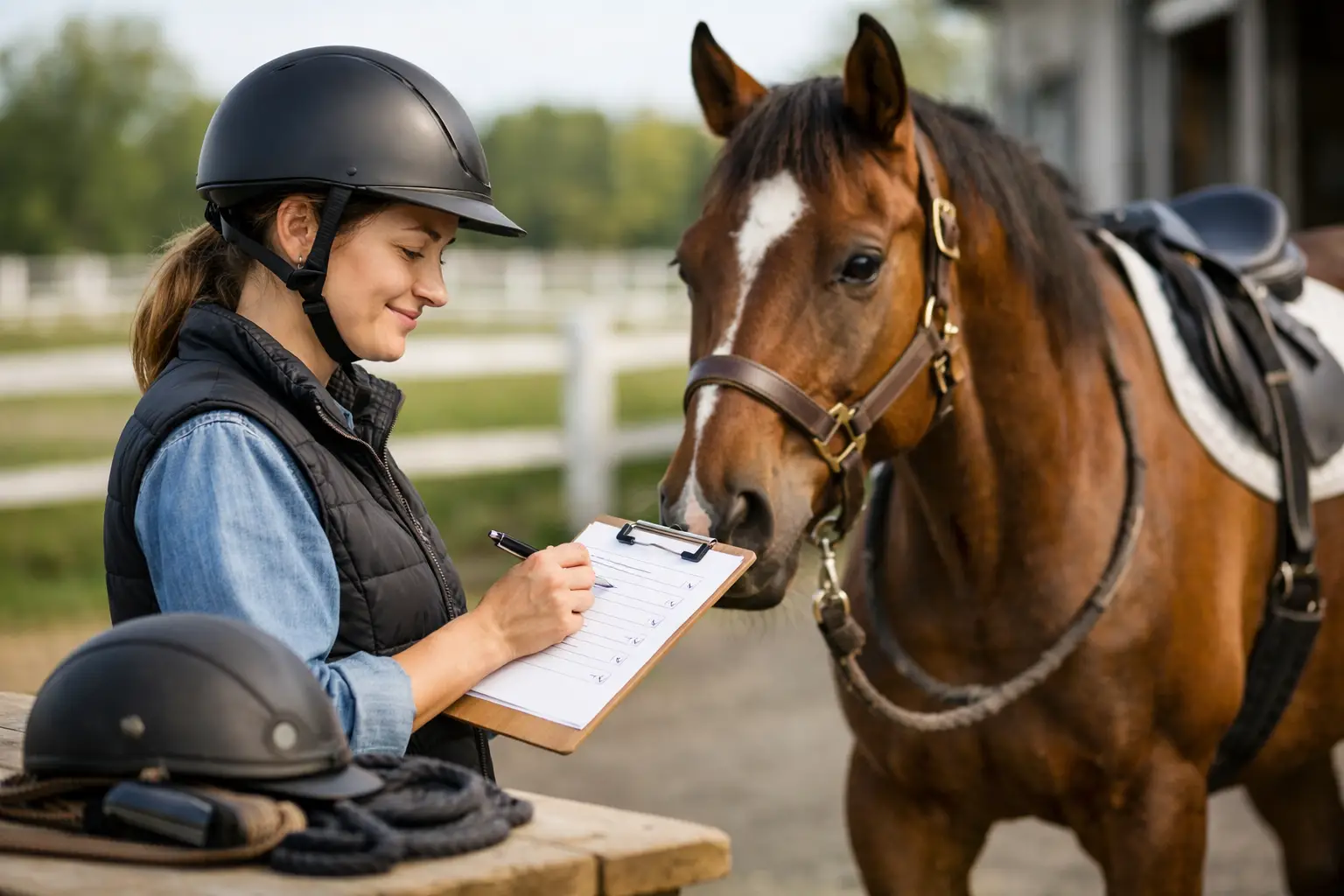
Here's the honest truth: your first week isn't about proving you two belong together. It's about slowing right down, watching, and giving you both a fair shot at settling in.
I know that's not the exciting answer. You've probably been dreaming about this horse for months, and now you want to ride, show him off, start the fun part. I get it. But this week is about safety and information, not a highlight reel.
Even a Lovely Horse Can Look Different at Home
Here's something worth knowing before you panic: a horse who was calm as anything at the viewing can seem like a different animal once he's actually moved in. New paddock, new herd, new person, new routine — that's a lot to process, even for a sensible horse.
That doesn't mean you bought the wrong one. It does mean this is the week to pay attention, not the week to explain away every little thing because you desperately want it to be perfect.
Get the Boring Stuff Sorted First
Before anything else, get his vet history, vaccination records, worming info and the previous owner's contact details all in one place — not scattered across old texts you'll never find again at 9pm on a Sunday.
And find your local vet, farrier and after-hours emergency number
now, while you're calm. Save them in your phone. Write them somewhere visible at the stable too. When something's actually wrong, you don't want to be Googling it with shaking hands.
Walk your property with fresh eyes as well. Gates, fencing, water troughs, anything poisonous growing where he can reach it. A horse who's new to a place will sometimes test a fence line or look for a way back to where he came from — that gap that looked fine yesterday can matter a lot more this week.
Keep Feed Changes Slow and Genuinely Boring
He does not need a celebratory feed because he's arrived. I mean that. Sudden changes to hay or hard feed can cause real digestive trouble at exactly the moment his system's already under pressure from the move itself.
Keep him on whatever he was eating before, for the first few days at least, then change things gradually with proper advice. Watch his water intake, his manure, whether he's actually interested in his feed. If he goes off it, paws, keeps looking at his flank, or his manure changes noticeably — don't wait until morning because you're worried about overreacting. Call the vet. Early is almost always the right call.
Introduce Other Horses Carefully
The herd can genuinely make or break how well he settles. A quiet companion over a safe fence is usually a far better first move than tossing him straight into a big established group and hoping it sorts itself out.
Some squealing and posturing is normal — that's just horses being horses. Repeated chasing, cornering, or him being kept away from food and water is not something to shrug off with "they'll figure it out." He needs time to settle. Not a week of being bullied.
Watch Before You Ride
I know the pull to just get on is strong. Maybe you've waited years for this. Maybe you're worried he'll get fresh if you leave him too long. But spend real time watching him from the ground first — how he approaches you, stands for the halter, leads, picks up his feet.
Watch his whole face and body, beyond whether he's technically doing what you ask. A tight mouth, a fixed stare, rushing feet — these tell you something's not settled yet, even if he's "behaving."
This is also exactly where your own boundaries start to matter, by the way. You can be kind to him without letting him crowd or drag you around. If you notice yourself bracing or feeling nervous every time you lead him, that's not you being silly. That's worth listening to.
One Predictable Routine Beats Five Exciting Ones
Keep this week short and repeatable. Bring him in at roughly the same time, groom briefly, lead quietly, put him away before either of you is frazzled. You're not trying to train every single issue in seven days — you're just showing him that people arrive calmly, ask fairly, and keep him safe.
Try not to have five different excited friends handling him this week, and resist the urge to test every button — lunging hard, a long first ride, loading him onto a float "just to see." Save it. Ordinary adjustment stress turns into a real problem fast when you pile too much on at once.
Write Things Down. Actually Write Them Down.
Take photos from both sides, front and back, and note anything — rubs, swelling, changes in weight. Jot down a few lines each day: appetite, manure, how handling went. It doesn't need to be fancy. "He was a bit funny" tells a vet nothing. "Went off feed Tuesday evening, dull by Wednesday, loose manure twice" gives them something they can actually work with.
Be Honest If Something Feels Off From What You Were Told
Some things that come up this week are just ordinary settling-in wobbles. Some genuinely aren't. If he's consistently bolting through you, threatening to kick, or you're becoming frightened to walk into the paddock — that's not a "give it more time" situation. That needs an honest, experienced look.
Getting help early isn't failure. Honestly, it's one of the kindest things you can do for both of you.
This Week Is About Information, Not Perfection
You're probably feeling a strange mix of love, relief and fear all at once. That's completely normal. It's easy to treat one good moment as proof everything's fine, or one hard moment as proof you've ruined everything.
Try to sit in the middle. Give him calm care, clear boundaries, and enough time to actually show you who he is. Then believe what you see.
There's a lot more ground to cover than one blog post can hold — the exact safety checks, the judgment calls on when something's an emergency versus a settling-in wobble, and the day-to-day confidence that turns this overwhelming week into ones you genuinely enjoy. That's exactly why I put together the
New Horse Owner Survival Guide — everything I wish someone had handed me in my own first week, all in one place.
👉
Get the New Horse Owner Survival Guide for $17