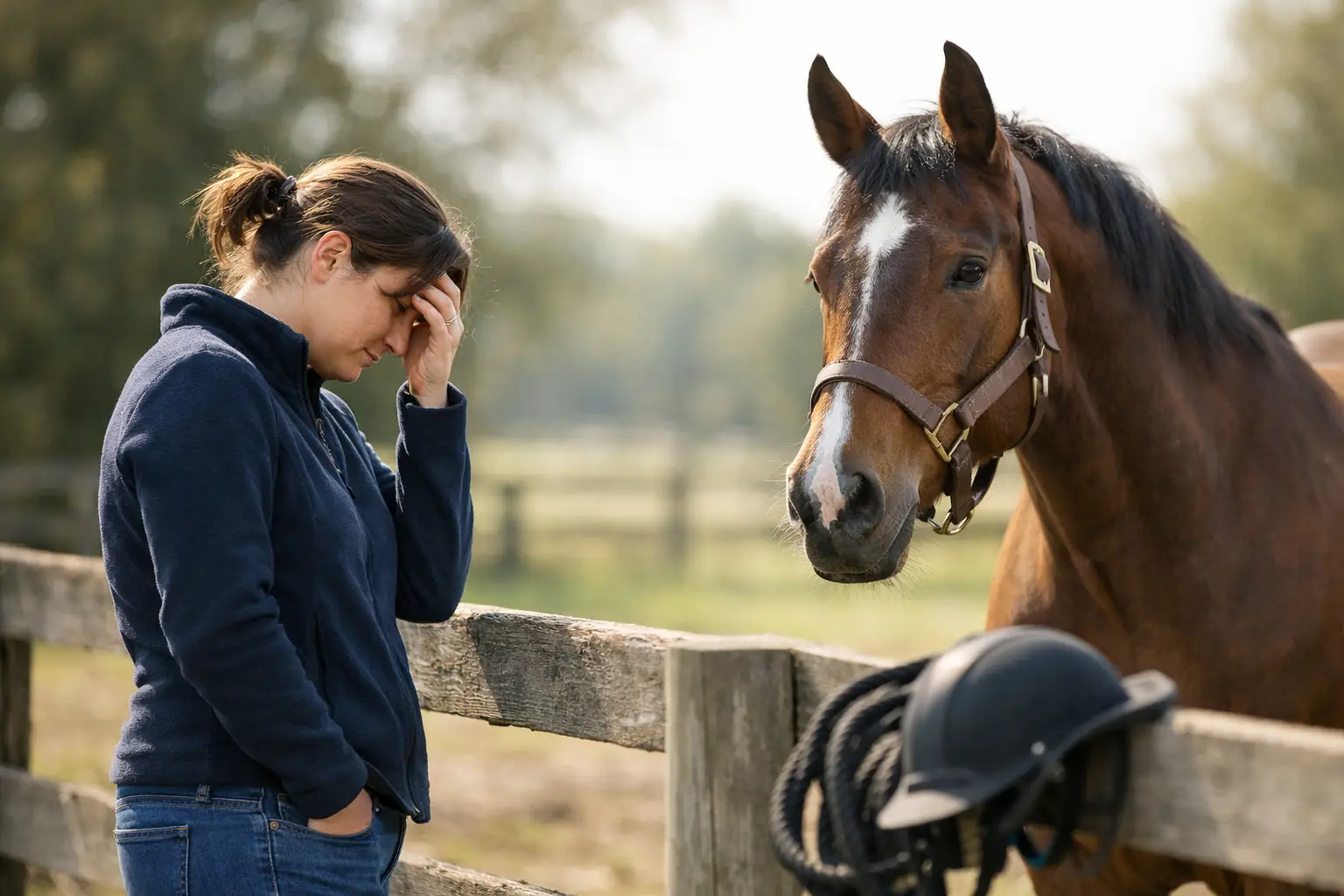

There's a difference between a horse who asks you to grow, and a horse who leaves you bracing before you've even reached the gate.
Working out which one you have isn't about labelling a horse as bad, or admitting you've failed. It's about being honest about the match in front of you — before lost confidence, an injury, or daily dread become the price of trying to force it to work.
A Challenge Isn't the Same as "Too Much Horse"
Most worthwhile horses test you sometimes. Green, sensitive, forward, opinionated — none of that automatically means wrong fit.
The real question is whether you have the knowledge, support, time and confidence to handle their difficult moments safely and fairly. If you're learning with proper help, recovering after a rough day and still enjoying the process, you're probably in a normal learning phase.
If every issue feels bigger than the last, and you're getting through routine handling on luck rather than skill — that's worth taking seriously. Hoping it settles eventually isn't a plan.
A Few of the Signs Worth Paying Attention To
There are ten specific signs that tend to show up before a rider admits, out loud, that something isn't working. A few of them:
- Anxiety before ordinary handling. Nerves before a competition are normal. Feeling sick about catching your horse from the paddock is a different signal entirely — and it's one riders talk themselves out of noticing.
- Boundaries that keep getting crossed. Barging, crowding, swinging hindquarters toward you. Some of this responds to correct groundwork. Some of it is telling you something bigger.
- Riding that's become survival, not learning. If your whole ride goes into stopping rushing, bucking or napping, there's no room left to actually build a seat — and no, that's not a personal failing.
- You keep finding reasons not to go. Muddy boots and hard days are part of ownership. Constant relief when someone else rides your horse instead is not the same thing.
That's four. There are six more — including one about money that most owners don't see coming until they've already spent it, and one about the people around you that's harder to admit than any of the others.
Why This Matters More Than It Feels Like It Does
Every one of these signs is manageable in isolation. It's rarely one moment that tells the real story — it's the pattern.
Louise Kropach has spent 20+ years working with riders and horses across Australia, including horses labelled dangerous and owners who'd quietly stopped trusting themselves entirely. The pattern she sees again and again isn't a lack of skill. It's a lack of a clear, honest framework for telling the difference between "this is hard because I'm learning" and "this is hard because this isn't the right horse for me right now."
What to Do With the Answer
If you recognise more of these signs than you'd like to admit, the next step isn't guilt, and it isn't forcing another ride to prove a point. It's getting a clear-eyed, unbiased read on the situation — ideally before the decision gets made for you by an accident or a burnout you saw coming.
And if you're weighing whether to work through it with your current horse, or whether your next horse search needs to look completely different this time, the same framework applies either way.
That's exactly what's inside The True Match™ Guide — the full 5 Red Flags framework, a workbook to clarify your own non-negotiables, and a printable checklist built for exactly this kind of decision, whether you're evaluating the horse you have now or the one you haven't found yet.
| What You Get | Included |
|---|---|
| The 5 Red Flags Framework | ✓ |
| The Full True Match™ 4-Module System | ✓ |
| Real Rider Stories & Case Studies | ✓ |
| Rider Match Profile Workbook | ✓ |
| Printable 5 Red Flags Checklist (PDF) | ✓ |
| Personalized Action Plan Template | ✓ |
Backed by a 30-day, love-it-or-it's-free guarantee.
You don't have to prove you can handle the hardest horse in the paddock. You just need to know, honestly, whether the one in front of you is the right one — and what to do next either way.