
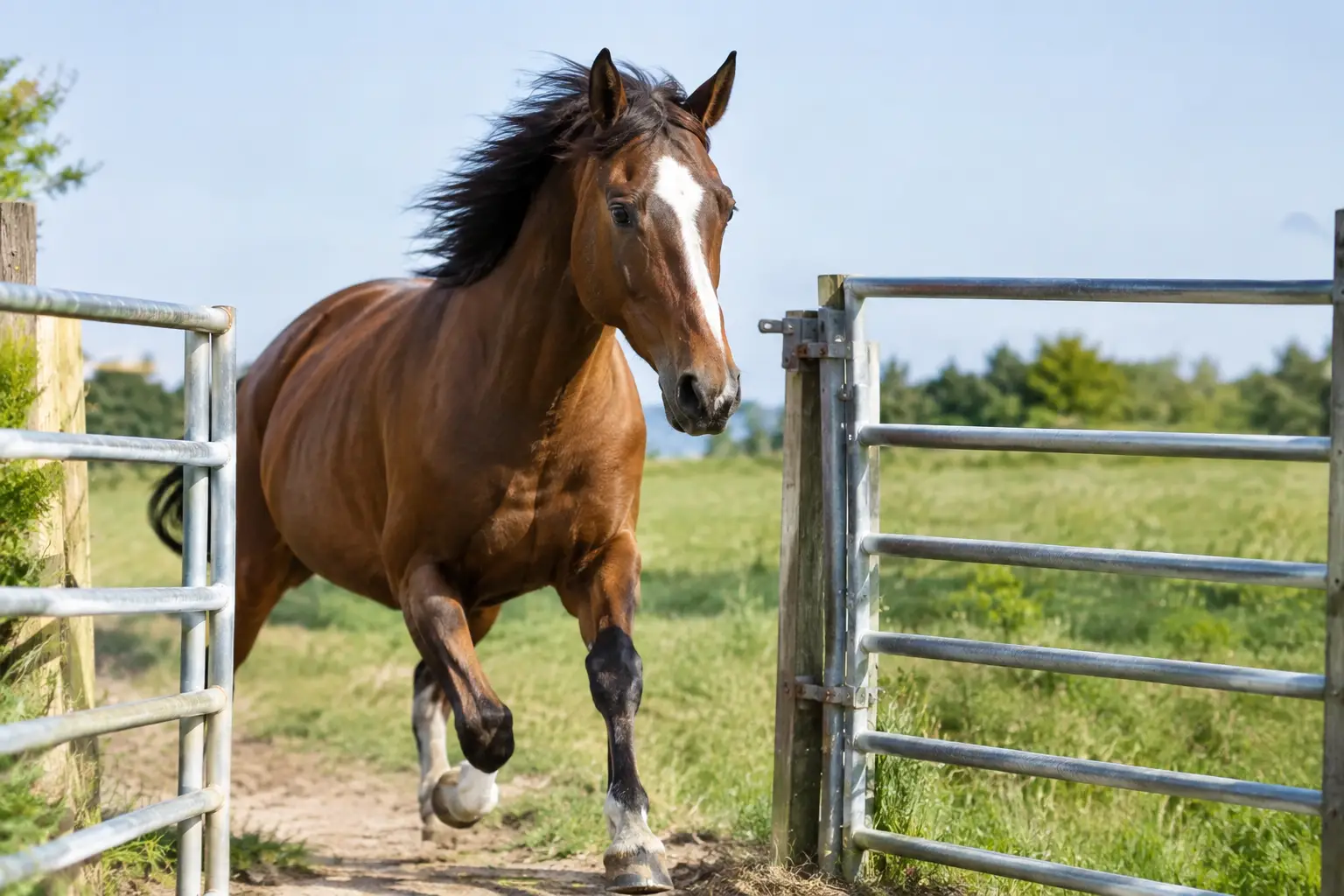
A horse that drags you towards a gate, shoves through it, or swings its hindquarters around as it goes can turn an ordinary moment into a dangerous one. If you are asking, “why does a horse rush gates?”, you are right to take it seriously. This is not simply an annoying stable habit. It can be a sign of anxiety, discomfort, learnt behaviour, weak boundaries, or a horse that has discovered people will get out of its way.
The answer is rarely as simple as “he is being naughty”. But neither should you excuse behaviour that puts you at risk. Gates are tight spaces. A horse that rushes one can knock you down, trap you between the gate and a post, pull free, or create a very real accident for a rider trying to open one from the saddle.
Why does a horse rush gates?
Most horses rush gates because the gate has become connected with something they want, want to avoid, or feel they need to reach quickly. The destination matters. Is the gate leading to feed, friends, turnout, home, shade, rest, or a way out of work? That context tells you far more than the gate itself.
A horse heading back to the paddock after a ride may rush because he is herd-bound or worried about being away from his mates. A horse charging towards the stable at feed time may be highly food-motivated and impatient. A horse barging through the arena gate may have learnt that once he gets his shoulder past you, the lesson ends.
There is also the simple reality that horses repeat what works. If rushing the gate has consistently got the horse to the grass, the feed bin, the other horses, or relief from pressure, he has been rewarded for rushing. He is not plotting against you. He is doing what has produced a result before.
That does not make it acceptable. Understanding the reason helps you address it fairly. It does not mean you must put yourself in harm’s way while you do.
Gate rushing can be a safety warning
Some gate behaviour is mild impatience. Some of it tells you the horse is too worried, too strong, too poorly educated, or simply too much horse for the person handling them.
Pay close attention if the horse pins their ears, crowds you, swings their hindquarters towards you, pulls hard enough to wrench your shoulder, strikes, rears, or becomes impossible to stop once pointed at the gate. Those are not small quirks to laugh off. They are moments where a handler can lose confidence, get injured, and begin to dread being around their own horse.
If this is a horse you are considering buying, do not accept “he’s always a bit keen for his dinner” as the whole explanation. Watch the horse being brought in and turned out by their usual handler. Then ask to handle them yourself, with appropriate support. A quiet horse should not need an experienced person to manage a basic gate safely.
Be especially cautious when the seller insists on doing every part of the handling, rushes you through the visit, or brushes off your concern. You are not being fussy. You are assessing whether the horse’s everyday behaviour suits your experience, strength, confidence and set-up at home.
Look for the pattern, not one bad moment
Before trying to fix the problem, work out exactly when it happens. A horse who only becomes hurried when being turned out with a particular paddock mate has a different issue from a horse who barges through every gate with every person.
Consider what happens before, during and after the gate. Does the horse start towing you from fifty metres away? Do they stop but lean on the lead? Are they settled once through, or do they bolt away? Does the behaviour worsen around feed time, after hard work, in hot weather, or when another horse calls?
Also consider physical discomfort. A horse rushing back to the stable or paddock after riding may be trying to escape an uncomfortable saddle, sore feet, pain, exhaustion, flies, heat, or pressure they do not understand. Behaviour is information. If the rushing is new, escalating, or appears with other changes such as grumpiness, reluctance to be caught or ridden, investigate the horse’s health and equipment rather than assuming it is purely a training issue.
Do not let the gate become a wrestling match
Trying to hold a determined horse with sheer strength is a losing game. It is also how people get dragged, stepped on, or pulled into the path of a swinging gate. Your aim is not to win an argument at the latch. Your aim is to create a clear, repeatable routine in which the horse waits because moving through the gate only happens on your cue.
Start in a low-pressure situation. Do not begin at peak feed time with a horse that is already wound up and a line of impatient horses behind you. Choose a calm time, wear suitable boots and gloves, and make sure the area is not slippery or cluttered. If you do not feel safe, ask a capable professional for hands-on help.
Approach the gate with enough room that you are not wedged between the horse and the fence. Stop before the gate, rather than at the latch. The horse should be able to stand without leaning, swinging into your space, or walking ahead of you. If they surge forward, calmly regain a halt and reset further back. Do not reward the surge by immediately opening the gate.
Once the horse can stand, open the gate only as far as you need. Keep yourself out of the crush zone between gate, horse and post. Ask the horse to wait while you move through the opening, then invite them to follow when there is room. Close the gate before you continue on. At first, that may feel slow and repetitive. It is far quicker than a trip to hospital or a loose horse on the road.
What calm gate manners actually look like
Good gate manners are not about making a horse stand like a statue for five minutes. They are about basic respect for space and a horse that can regulate themselves around everyday pressure.
A horse with useful gate manners can approach without dragging, stop when asked, stay out of the handler’s space, wait while the gate is operated, and walk through without exploding forward. They can also tolerate being asked to step back or yield their shoulder if they crowd the opening.
This is where groundwork matters, but it must be clear and consistent. If you sometimes allow your horse to barge because you are in a hurry, then correct them the next day, the rule is muddy. Horses notice patterns. Make the same request every time: your space is yours, the gate is not theirs to claim, and forward movement comes after a cue.
Avoid escalating into shouting, yanking or smacking in a confined space. That can make an anxious horse more reactive and a pushy horse more defensive. Calm does not mean passive. You can be firm, timely and absolutely clear without turning the lesson into a fight.
When rushing gates means you need help
There are situations where practising at the gate is not the right first step. Get experienced, in-person support if the horse rears, strikes, kicks, spins, bolts through gates, threatens to run over you, or has already injured someone. The same applies if you are frightened. Fear changes timing and body language, and there is no shame in recognising that you need support.
It may also be necessary to change management while the behaviour is being addressed. Feed horses separately where possible. Avoid taking one horse away from a highly bonded companion without a plan. Use safer turnout routines and ensure gates, latches and fencing are functional. Training cannot compensate for a set-up that repeatedly creates panic or competition.
For riders, gate rushing under saddle deserves the same caution. Do not keep trying to open a gate from horseback if your horse braces, spins, backs up unpredictably or surges through. Dismounting may be the safer choice while you work on the underlying issue in a controlled environment.
A gate is a small test of a much bigger question: does this horse understand personal space, cope with frustration and respond to simple direction when something exciting is ahead? You do not need perfection. But you do need a horse whose ordinary handling is safe enough for you to enjoy owning them. That standard protects both of you.